
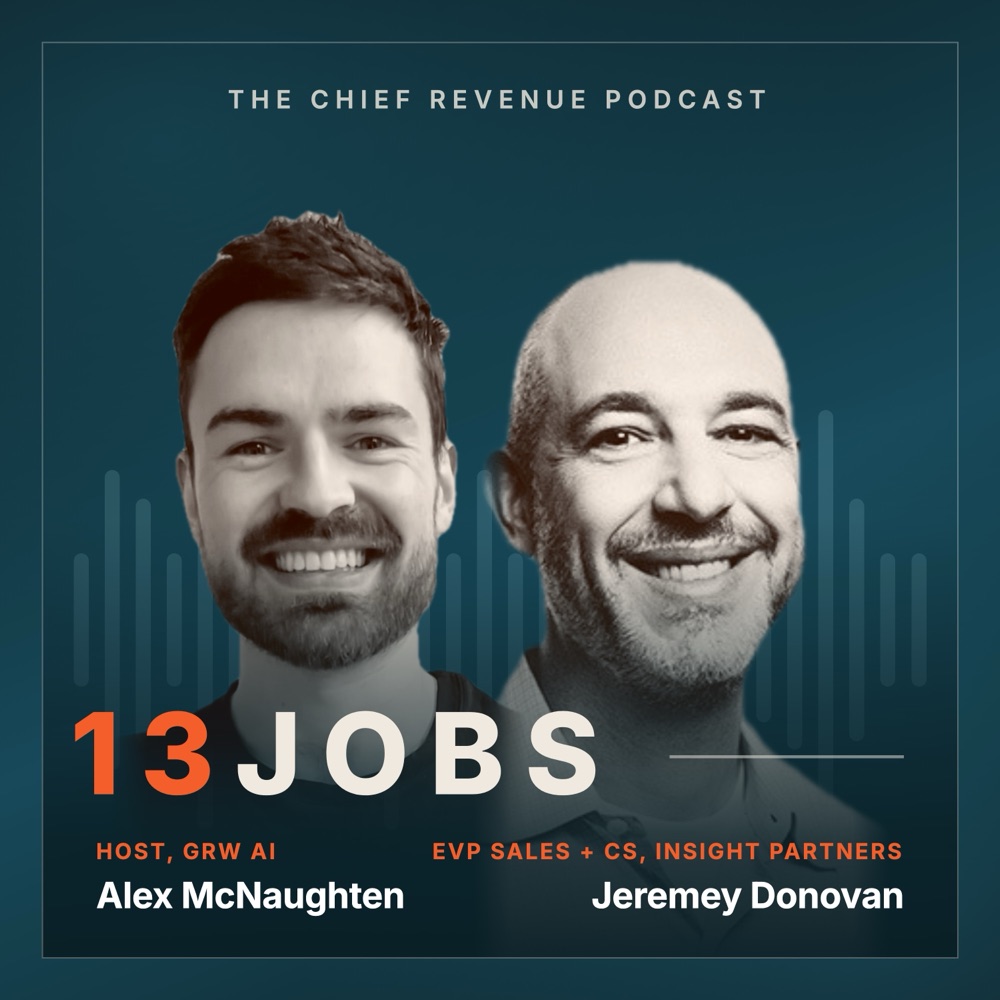
Adopting a systems-based approach to AI
Why the next wave of AI in revenue teams is a coordinated, top-down project rather than a stack of point tools reps pick up on their own.
 Hosted by Alex McNaughten
Jeremey Donovan · EVP Sales + CS, Insight Partners
Jeremey Donovan is the Executive Vice President of Sales + Customer Success at Insight Partners, one of the world's leading growth equity firms, where he partners with portfolio company leaders to scale commercial teams and build repeatable, data-driven revenue engines.
His career spans over 25 years and cuts across semiconductor engineering, product development, and sales and marketing leadership - giving him a genuinely rare vantage point on how to apply rigorous systems thinking to the messy, human world of sales.
He's held senior roles at SalesLoft, CB Insights, GLG, Gartner, and the American Management Association, and brings both the operator's instinct and the engineer's precision to everything he touches. Jeremey is the author of five books, including the international bestseller How to Deliver a TED Talk and Predictable Prospecting - a title that tells you everything about how he thinks about go-to-market.
He's also an Adjunct Professor at NYU School of Professional Studies and the host of the Hey Salespeople podcast. He holds an MS in Data Science from the University of Virginia, an MBA from Chicago Booth, and a BS and MS in Electrical Engineering from Cornell.
In this episode, we discuss:
- 1.The survey of 180 CROs behind his systems view of AI
- 2.Why a transformative AI use case can't be driven by an individual rep
- 3.What changes in 2026: coordinated, top-down implementations with real enablement
- 4.Why the use cases that spread are the ones embedded where people already work
- 5.Experimental AI budget, and what that does to vendor claims
- 6.How he actually measures whether AI is doing anything
- 7.The tractor argument, and why “AI won't take your job” lacks empathy
- 8.The outbound maths: ops per SDR, win rate, and the ACV floor it implies
- 9.When low-ACV outbound still works, and who actually picks up the phone
- 10.Why brand recognition sets your outbound velocity
- 11.Killing “it depends” by codifying context into decision trees
- 12.What's overhyped: AI outbound prospecting, and why we detect patterns not AI
Quote of the show
“I hate giving an "it depends" answer. I want to be able to give a prescriptive answer based on context, and that context can be codified.”
Key takeaways
- The AI that matters is a top-down project. Data wrangling and systems access sit above the rep. An AE or SDR does not have the keys to the data warehouse, so the transformative use cases need coordination, not individual adoption.
- Embed it where people already work. The use cases spreading fastest are the ones integrated into the tools reps already open, not a new destination you have to persuade them to visit.
- Judge AI by the numbers you already track. If bookings and productivity are improving, something is working. Clean attribution to AI specifically is mostly unknowable, and chasing it wastes the quarter.
- Outbound has a maths test. Around six qualified ops per SDR per month at a 20% win rate, with SDR cost held under 10% of cost of sale, implies roughly a $40K ACV floor. Below that, move the money to inbound or channel.
- Velocity is the exception to that test. A low-ACV product can still outbound if the persona picks up the phone. Small business owners do; mid-market and enterprise connect at about 5%.
- Brand sets outbound velocity. The same motion works better when the name is recognised. That means being present where your buyers already are, not buying a Super Bowl ad.
- Replace “it depends” with a decision tree. Context can be codified. Ten or twelve contextual questions produce a concrete answer on things like hybrid AE/AM roles or whether you need CSMs.
Transcript
Jeremy, thank you for making the time to come on the show today. How are you doing?
I'm doing great. I've been listening a lot to your podcast, so it's good to finally put a face to the voice.
I know it's always fun doing that, right? When you're preparing to either go or be on a podcast and you sort of listen to the other person and then you finally meet them, you're like, I've heard probably 2 hours of you talking at this point.
By the way, you match your voice.
Oh, that's good.
Some podcasts or some, some, you know who doesn't for me is John McMahon. I love his, uh, the Revenue Builders podcast. And like, I listened to it for so long and then when I saw pictures of him or video of him, I'm like, wow, I just had a very different impression of, uh, of him.
Well, I'm glad my voice, I'm glad that it's not too jarring. Um, so for those who don't know, Jeremy Donovan, um, started his career as a semiconductor engineer. Currently works as an operating advisor on sales and customer success at Insight Partners, who are one of the largest software investors in the world. Jeremy works across their portfolio of over 500 organizations, which gives him a very unique view into what's working and equally probably, you know, what's not working in go-to-market right now.
And the reason I asked Jeremy onto the show is I was listening to a conversation he was having with my friend Carl Norton, where he stressed the importance of a systems-based approach in AI. So that's where I'd love to start this conversation. I want to pull on that thread a little bit. What is a systems-based approach to AI, and how does it compare to a bottoms-up approach?
Like, what do both of those look like in practice?
Yeah, that the That kind of came up a little organically. I do think that 90— I'm going to answer the question, but I'll preface this by saying I think 99.9% of whatever comes out of my mind is not original. I think I must have heard it somewhere else. So I'm getting old enough now that I can't exactly remember where I heard it.
But what dawned on me was the following. So we did a survey recently, I think of about 180 of our CROs, of our chief revenue officers. And we asked them all kinds of questions, but we asked them about AI. In particular. And then we follow— we've been following up with them. And in the AI section of that survey, we probably had, I don't know, 25 use cases.
And we asked them where they were on the maturity curve, like, are these adopted, high value, or are they, you know, not adopted or whatever? And so the follow-up that we're doing is we looked at all the CROs who said adopted, high value on very particular use cases. And now we're going out and talking to them and say, Like, what is, you know, tell me about what you're doing.
And that survey we did 3 or 4 months ago, and already a lot of them, you know, have either advanced those or layered on a whole bunch of more ones or even killed some of the ones that they were doing, you know, 4 months ago. But one of the things that stood out to us when we were going through it was the adoption in 2025 was really centered around like what an ambitious AE or SDR was doing in their evenings and weekends.
And then it worked and it caught on. And then, you know, the smart companies scaled that.
Right.
And therefore the use cases had to be things that could spread through that you know, that mechanism. Um, the flip side though is, is like that— here's the engineering thing coming into my, you know, like into my consciousness, right? Which is this whole concept of a, of a local maxima, right? Is like you may think you're at the peak, but, but there may be a much higher peak of effectiveness and efficiency somewhere else.
You just didn't climb that mountain. You didn't go that path. So I think there's a separate peak, which is there's a set of things that are more complicated to implement that one person, you know, couldn't— one person could do a heck of a lot more than they used to be able to do.
Yeah.
But it's when you're doing a, like, a very transformative thing, right? Strategy, that's people, process, and technology. And it's going to be hard for one person who is an individual contributor, AE or sales or SDR to do that. Like, and a lot of it is data wrangling and systems access, especially for larger companies, right?
Like an individual AE or SDR is not going to have the keys to the kingdom on getting into the data warehouse.
Yep.
Is not going to be able to put in tech that is going, you know, like agentic tech that's going to execute actions on core systems of record.
Mm-hmm.
You're just not gonna be able to do that. So that was, it's a very long-winded windup, but the long-winded windup was like an aha that, that if, if there's something new, and I, I'm always like, I think everyone's always saying this is dead, that's dead, this is new, that's new. Again, like I'm, I, I've been through enough of this to realize that things change, you know, kind of more slowly than people would think.
Or that, or that, or, you know, and sometimes it's a bigger change. But anyway, like on this note, if there is a change in 2026, I think it is that we're going to start to see some of these more complicated use cases that are going to require a very different way to implement.
And it's going to be a much more top-down thing to do where we say, you know, I need to open up access to these systems. And I need to do this in a really coordinated way. And as I was listening to one of your guests, I think it was like 2, 3 episodes ago, who was talking about enablement and, and like, that's critical also is that you, you can't just sort of like throw this stuff out there, especially as you get to larger and larger organizations.
You know, you just need to repeat, repeat, repeat. Train, certify, you know, like, you got to put a— humans are slow to change. So you got to put equal effort into the last mile, which is getting that technology adopted and refined.
I think that very much tracks to what we've seen, which is approximately 25 to 35% of people will just run with run with the tech irrespective of whether you show them how to use it or not.
Hmm.
And then you've got the kind of middle biggest bucket, call it 50%, who with a bit of encouragement and a little like showing how to use it will adopt it pretty quickly. And then you'll have the laggards. And I think that like that fundamental kind of breakdown hasn't really changed with AI compared to like the last gen of software.
It's like it's always kind of been that way. But it's perhaps been a bit more surprising for me because this kind of next generation of, you know, call it tooling for lack of a better word, is so much more intuitive to use and actually doesn't really have a learning curve. And I'm curious, like, what's your take on that?
It's like when there's no user interface to learn and it's just now you've got this AI agent who maybe lives in your Slack or lives somewhere else. What do you think is causing— why do you think the adoption pattern is very similar to what we've seen in the last generation of software?
In every generation, I think people often forget. I think it's just something that's always— it's not new. I think it's something people often forget is it's— there was, I think it was election many years ago in the US and it's It's the economy, stupid, was the expression, because that's what matters when you're getting votes here.
In this case, it's the UX, stupid. You know, like, there were so many attempts to put people onto their pane of glass.
Yep.
Using a little bit of a dated expression, when I think the acknowledgment— and, you know, obviously Apple really brought this to the forefront of everyone's consciousness. Right. I think, I mean, there was probably people who did it long before Apple, but, you know, the design was so that you could ship this, the phone.
I use an Android phone, by the way, but that's neither here nor there. The design was that you didn't ship an instruction manual, right? Like, it was just so intuitive out of the box. And I think it's the same in sales tech and in all things, by the way, that like it hopefully should be that intuitive and absolutely the natural language interfaces.
Right? Just do make things so much more intuitive. And to the other point that you made around like using a messaging technology, right? People are in their email, they're in their, whatever their messaging tech is. And those are like the main 2 places they live, frankly.
Yes.
So to the extent that you can integrate this stuff directly, that's super powerful. In fact, Of the, you know, we've now, of the 180, I think we've talked to 20, 25 CROs so far in just the last month. And in my own mind, at least, I'm ranking who's most mature, right? Like, I'm not formally doing it, but in my own mind, the most mature sticks out.
And there are 2 or 3 companies of those 20, 25, 20 to 25 companies who are like really, really mature. The far and away head and shoulders most mature company. All of the use cases are delivered through their Slack.
Yep. That's nice.
Yeah, which was fascinating to me. And there's a lot of, you know, they're a very AI-centric company, even in their product and, you know, everything that they do. But the extent to which they have this incredible hidden complexity, right, behind the scenes that then gets surfaced via their messaging interface is quite fascinating.
So yeah, I agree. But I think that's a design principle that we just sometimes forget, but it's always true. You know, it's like, you got to just serve people where they are.
Yes.
And not try to get them to do— it's not, again, it's not impossible to get them to do something new, but It's, it's pretty hard. It's why, you know, it's why the category creation thing has gone a little out of, out of, uh, vogue in the last couple years, right? Is it's much easier to glom on to saying like, hey, I'm, I'm the next generation of the existing thing.
Mm-hmm.
I'm not creating something that no one has thought about or heard or used or whatever. It's on the category creation side, like the same thing is ties to, you know, another episode of yours I was listening to where someone brought up, you know, different sales methodologies, right? Like the challenger thing is a little less in vogue right now because that was— people who haven't read the book misinterpret that.
They think it means like being confrontational. It doesn't mean at all confrontational, right? Challenger boils down to teach, tailor, and take control.
Yes.
But the, the The gist of it though is that you're coming to somebody and helping them realize that they have a problem that they're unaware of or an opportunity that they're unaware of and trying to educate them towards that. But that's again, like it's violating a more natural path. It's not that you can't do it, but it's hard.
Yes. It takes a lot of finesse, I think, to do it well. And I don't think the vast majority of sales teams have the required level of finesse to do it consistently from what I've seen. Because it's hard, it's a skill, you have to learn it.
For sure, it's a skill. And it's also expensive, right? Because persuading people to do something that they're not anticipating doing, Yeah. Just takes more elbow grease, right? So like, yeah, yeah. And it's not to say again that things can't, you know, that things can't pop up in every price range. Like I was just, my pause there was I was thinking about, right?
I mean, the thing that has been the center of our, a big center of our conversation, which is the GenAI interfaces. And I mean, that's pretty category creating, right? And it violates the principle also that category creating things need to have high ACV because it doesn't have high ACV. So it just proves that there's an exception to, you know, to every rule that you have a breakout category that's, you know, or sorry, breakout, yeah, new category that is, that is like consumer pricing.
Yes.
You could argue that these companies are losing hordes of money. So, to be determined what the actual ultimate right business model is. But yeah, I just had another— sorry for the rambling, but I just had another thought of like, and this will date me, but I remember the first tech bubble and we loved it as consumers because All these companies were giving away stuff hand over fist, right?
Like, we had— we've always had cats, so we had a lifetime supply of like cat food and litter just being shipped to our apartment because everybody was falling over themselves to like give away stuff. And so, like, in the end, those didn't turn out to be good, you know, great businesses. I think these businesses are still trying to figure out how to, you know, how to make money.
I shouldn't even say that. It's obvious they're still trying to figure out how to make money.
For sure. Talk to me a little bit around the disparity between what AI vendors claim will happen when you implement their solution and then what is actually happening in the organizations. I think the reality is the productivity lift, for example, is not as dramatic as maybe people hope. I'm not saying that there isn't a lift, but what I've been trying to figure out here kind of more broadly, if I look across the space, is, are people implementing this wrong?
Are people just not doing it right? Or are the promises too much? Or is it actually just a muddy combination of both?
It's muddy, but I mean, to give some clarity to it, I guess, from what I'm seeing, right? I don't have the magical answer here, but to give some clarity to it, some of the things I've observed. One is, there's definitely a lot of buyers out there who just have AI budget. And it's, it's kind of experimental budget.
Yep.
So they're throwing money at it. And those things may or may not, you know, may or may not renew, to be determined. So I think there's a bit of You know, there's a bit of that going on. The other thing is, you know, around ROI of AI. You know, we, we, we would love to be able to measure the ROI of AI on an operation, you know, operate, we separate like operational AI from the AI in your product.
And I'm pretty tightly confined to AI operationally, in particular in sales and customer success. And, and I like, I think it's extremely hard, if not impossible, to measure what the impact is. And I'll wind the clock back another like dated but still extremely relevant story that years ago, before ChatGPT was around, I was working in a startup.
And this is when COVID hit. And right after COVID, like, there was like a first wave of COVID and then everything opened up and there was this great resignation, right?
Yes.
And everybody was switching, you know, they'd been pent up and they all switched jobs. And we lost a huge swath of our customer support people within like a 2-week span. It was really, really fast. And our CSAT immediately dropped on support ticket for, right? Because we just were responding more slowly and mainly responding more slowly.
So we had to fix that in a hurry. And we knew it would take a long time to hire and ramp people. We're going to do that also. But in the interim, we needed a tech, like we were hoping there was a technological fix. So we hunted around and shortlisted a couple vendors.
And one of the vendors that we shortlisted, like was really on the bleeding edge of what AI was at that time. Pre-ChatGPT was, you know, NLP, natural language processing. But it did a great job. Like it read our support data knowledge base and, you know, and gave great answers. It helped with, you know, triage of the questions.
It was excellent, excellent. So like when I went to the CFO to get final approval for the budget for that, He basically said, and he always wanted business cases, and he basically just said like, look, if you can get our CSAT back up above a certain level, right? 4.5, I think it was, because it had dropped from, I don't know, 4.7 or 4.6 to 4.3.
And even those little differences matter a ton in a SaaS business, right? Where you, you know, you're dependent upon retention. So if you, if it gets us back above a 4.5, I'm happy. You know, within a— if within 6 months it gets us back above 4.5, that you don't need to come back to me anymore.
Like, I'm happy, we'll renew the product. And, you know, our company did do that quickly and we renewed year after year after year. And then, you know, obviously when ChatGPT came out, you know, we continued with that vendor and it just got better. Or I left post, you know, at some point, but they continued to renew and as that technology got better.
But my point there is like, We couldn't measure the ROI on that, but it was one of many solutions that brought us back, right? It wasn't just that one technology that got us back there. And we could probably do some funny math to quantify it, but that's my point about ROI. What I— what the measure I look at, and I was kind of triggered, inspired is, I think, is too highfalutin of a word, triggered to look at this was, I think there was a Satya Nadella quote on, you know, somewhere out there where he said, like, we'll really know AI is working when we actually see, you know, revenue increase or corporate profits.
Like, there has to be some measure that's a very high-level financial measure. And the one I track is ARR per FTE. Or sorry, annual recurring revenue, right? People probably all know, but just in case, an FTE is full-time equivalent, like per fully ramped employee. Or I'll look at net new ARR per ramped sales equivalent per salesperson, basically.
Yep.
And like, if those numbers are improving, that I'm generating more revenue or more ARR for the company, more revenue, you know, more net new ARR bookings, then like, I don't know if it's AI, but I know we're doing something right, you know?
Yes.
And if it's not, I can conclusively say, I mean, I shouldn't say that. It could be that AI is boosting what would otherwise be something, you know, a decline. But, you know, I mean, it shouldn't just like, I'll I think I'm safe to draft off of the wisdom of Sachin Nadella. So I think that's what I'm looking at.
And we are seeing it for sure. And it's not across the portfolio. It's not— there's no quarter where the slope has changed dramatically.
Okay.
It's been a, you know, like the improvement in those numbers has been linear.
Right.
Right, that we're kind of improving our productivity. And that's my best guess of, like, where there's an impact of AI. There sure are other things going on, right? Like we switched the whole world, right? Switch from growth at all costs to efficient growth. And as a consequence, you know, they looked at their processes.
There was, you know, to use a euphemism, right-sizing of teams. So that's also going on. So I can't say it was exclusively AI, but it definitely, right, like is improving. And I think AI is a big part of that. I think I'm comfortable saying I think AI has made everybody 10% more efficient.
And there's some real dark side to that societally also, like we shouldn't just all celebrate that, you know. One, one last riff on, or like the thing that popped into my mind on that, and stop me if I, you know, if I ramble here, but I'll often hear this expression, um, AI is not going to take your job.
People who—.
Yes.
Know AI or fluent with AI will, will take your job. And it really, that really bothers me. It gets my goat because, um, You know, think about the agricultural— well, the first industrial revolution, I should say, right? It's not that a tractor is going to take your job. It's that the people who know how to drive tractors are going to take your job.
Like, yes, that's— it's not untrue, but it is true, right? But the problem is you're going to leave vast swaths of people, right? Unemployed. And that expression, what bothers me is it puts personal responsibility on like every individual. And yes, I think there is personal responsibility. And I like, I personally am trying to keep up with AI as fast as I can.
But I think you need to be empathetic to the fact that not everybody is going to be able to transition. And, and, you know, there's going to be 1 tractor driver for every 10 people who used to be in the field. So, yeah, it worries me for sure. And I don't like that expression because I think it lacks empathy.
I think it's a really good point you've made. I guess like the, the optimistic view is that we will create new jobs that will keep people busy in more interesting ways potentially than maybe where they're spending their time today. Which I tend to orientate myself very optimistically, so that's kind of the one I lean into.
I think the open question is though, is like, what and how? I think no one can really answer that very well yet, but that is—.
Yeah, yeah.
You know, I guess my optimistic hope here.
Yeah, I fancy myself an optimist, but I also look for disconfirming information and look at data. And in this case, right, I mean, I don't know globally, I should be more globally aware, but I can say in the US, the macroeconomic situation is a flat job market, right? Like, we're not adding jobs in a significant way right now.
We're not decreasing jobs in a significant way despite the fact that there's huge growth.
Yes.
So I think if you look in tech specifically, right, like the large tech companies, right, you just hear about these monster layoffs.
Yeah.
And originally years ago, it was okay, they hired too many people. Probably true, you know, but it's— that's all been— that's years— that was years ago, you know, like that's all been worked through. Now I think it is, you know, if we're 10% more efficient, you know, then even if you're growing, you might not hire as many people as you did before.
So anyway, that's a side rant, I guess, on all this. But we just— I just— if I get the chance to be on a soapbox on a podcast, I want to make sure that we— Don't all just run around saying it's not AI that's going to take people's jobs, it's people who know AI that will.
It's insensitive to me.
I do tend to agree with that. Kind of changing tack a little bit here, outbound is always a controversial topic that comes up in sales. And I think if you log into Twitter or LinkedIn at any point in the last 5 years, you'll have seen someone professing it's dead and someone professing that it still works perfectly.
Their specific framework. And, you know, I think both of those are probably true. The number of touches to create an opportunity, though, has significantly increased. The effectiveness of certain channels has changed. So I guess my question to you is, with the rise of like AI-generated content and You know, what feels like, as a receiver of a lot of outbound, just noise at this point.
Yeah.
Is cold outbound viable, or should we take those same investment dollars and actually put them somewhere else?
So, I'll start by saying outbound is not dead. You know, direct mail is not dead, right?
Which is crazy, but Yeah, outbound's not dead.
It depends on context.
Yeah.
So let me take 2 different situations. And these are like real. In the last week, I talked to portfolio companies who were both in these situations, in these 2 different situations. So on the surface, right, if you think about outbound for, let's say, mid-market or enterprise these days, A typical SDR can book about 6 qualified ops per SDR per month, maybe lower, maybe, yeah, could be 5 or 6.
It's not a lot. And if you assume, you know, a 20% win rate and then you back calculate, like, and then you also assume I want the SDR to add no more than 10% to my cost of sale. If you put all that in the, whatever they call it, a Gronculator, right? Like you're going to come up with, it's got to, you have to sell a product that, that has about a $40K ACV.
Right.
Um, and anything below that, right, you should, you should not outbound and you should instead take that money and redirect it to inbound and/or channel. Um, so that's like the generic advice. Okay. So In those 2 examples, one of the portfolio companies, $25K ACV, mid-market enterprise, 20% win rate. And, you know, in that case, our guidance to them is, is like, you got to shift the money because it's just not going to work.
I'm on the phone then like 2 days later. It's just, we're talking on a, on a Monday. So this is late last week. And this company says, you know, our ACV is $15K and we're thinking about outbound. Should we do it or not? And where my mind goes is I can't just immediately give that generic response.
I got to understand who they're selling to and what the velocity is. And I think one of the key things in this is, okay, so they're super high velocity.
Hmm.
And The key difference is in mid-market and enterprise, the connect rate, the percentage of the time people pick up the phone is about 5%.
Yep.
And then they might just pick up the phone and like I get calls and sometimes I pick them up and then I say I work for, you know, a venture capital firm. We don't buy sales tech, but I wish you good luck and keep up the hustle. But that's a connect, right? That's one of the 5 in 100.
Yeah.
But this particular company sells to an ICP, a persona I should say, that has to pick up the phone. They're kind of small business owners and small business owners pick up the phone in most cases. So therefore they can have a, you know, a one-call close or a 2-week sales cycle and a 40 to 50% win rate.
So like $15K can work for them. So that's my first comment. I have another kind of key comment I think that really matters. And this is— I stole the beginning of this from another podcast I was listening to, but the rest of it I have some, hopefully some degree of originality. Thought on.
What I saw from the podcast is somebody was saying it used to be, and a lot of people run around saying this, that like it used to be that you could have, you could sell, sorry, a great sales team could sell a mediocre product. And on this podcast, the guest said, because they were asked, I think, what's one thing you now believe that you that you didn't used to believe or that you didn't once believe?
And the guest said, and I totally agree with him, he said, I used to believe this. I used to believe that if you have a great sales team, you could sell a mediocre product. He said, now I think you need an exceptional product. And like, that's a precursor. You can't succeed if you have a mediocre product.
You're dead. And I agree, like, I see it all the time that the biggest thing that differentiates successful companies is absolutely the product. And in fact, they can sometimes have a pretty messed up, you know, sales strategy and still succeed.
Yeah.
So product, you know, product, I think the product comes first, but where I'm going with this on the outbound side is Outbound, again, it's all about velocity and your velocity is just going to be so much better if your brand is well recognized. So that's the other thing here, which is, I mean, it's incredibly important to invest in brand and that can mean a lot of things, right?
Like it doesn't necessarily mean— we're recording this shortly. I'm not a sports fan, but we're recording this shortly after the American Super Bowl. It doesn't mean put a Super Bowl ad up, right? It could mean that if you're a DevOps solution, you're all over the communities.
Yeah.
Contributing. It could be at events speaking. It could be content marketing. It could be like whatever. And this all ties together. You have a great product, which kind of doesn't exactly sell itself, but it definitely softens the beaches. So that when your AEs call or email, you're much more likely to get a response.
So anyway, that's my unpacking of, if you told me nothing, I would say to you, outbound is alive over $40K and dead below it. But with more context, I might give you a different answer.
Yeah, I think that's really interesting. And most of the takes that you read online don't actually acknowledge that. They just say it's dead. It's like, well, maybe, like, tell me more about the situation. Why is it dead for this specific situation versus that one? And I think what you've articulated there is, I think, what's missing from most of the online discussion around this topic.
Well, yeah, I mean, of course, right? The online discussion, there's a couple of motivations behind that. One is they're selling something, you know, And then, or they, or they want clicks.
Yeah.
And I don't really care about selling anything or getting clicks. So I try to tell it straight. And like, the truth is, it's like everything is context, right? Everything is context. And I mean, talking sales today, but like, everything is context.
Totally. I've got 2 questions.
There is an answer. That's, that's actually something that's like, that was when I got to this job 4 years ago. I would sometimes hear our team would say like, it depends, and then they would kind of leave it at that. They didn't always do that, but they sometimes did, and it drove me crazy.
And, and one of my colleagues and I sat down and like drew a whole bunch of really, really complicated decision trees. Because I hate giving an it depends answer. I want to be able to give a prescriptive answer based on context, and that context can be codified. And then since those things were so complicated, we turned them into a little script.
And now people can just, on certain things, you know, answer whatever, 10 or 12 contextual questions, and then it will output, you know, whatever. So for example, organizational design, should you have AEs and AMs as a hybrid role, or should they be separate? I mean, it depends, right? Should you have CSMs or not?
Should you have technical account managers? Should you have product specialists? Should you have whatever? You know, like all of these things, there's a— there is actually a concrete answer to every one of these things if you ask the right questions. Yes.
I've got 2 questions here before we wrap. Number one is, what's overhyped?
I lost your audio.
Oh, can you hear me again? Am I back? Cool. Still no? Um, let's see. How about now, Jeremy? Testing.
Yes. Let me see. Can you hear me?
Yep, I can hear you.
Okay. All right. We switched audio, but let me try to get this back so it's consistent for you.
No worries. I can still hear you. We're back.
No. All right. Can you hear me?
I can still hear you. Yes.
Okay. Okay.
The audio is coming through fine. I think it'll be okay. 2 questions left. Number one is, what's something that's overhyped right now in go-to-market that you think will quietly disappear in the next few years?
Ooh, this one may require an edit. What do I think is overhyped right now? Um, you'd be the, you'd be the decider of this, but I think like AI for, um, outbound prospecting, you may argue that it's not overhyped anymore, but I, I, I think that that is—.
Yeah.
Maybe I'm not prognosticating so effectively, but I think that is really troublesome because of what you mentioned earlier. And one more thing, which is one, is it just enabling too much garbage. But also, humans, we think we can detect AI, but it's actually not that we're detecting AI. What we're detecting is patterns.
And when we see everybody use the same pattern, we say, oh, that's AI. Right. So I think I think anything, these come in, they're like fads. They come in waves. It was true with like those video prospecting and other things. Like it just comes in waves. So you just have to keep staying on the like innovative edge of this stuff.
And as soon as you can have the machine do it and everyone can buy the thing that the machine can do, it's dead. Yes, that is dead.
And I think that's a really good point. I think that shows up really, really quickly in outbound, really, really quickly. So I do tend to agree with you. I've played around with some of these, these things mostly out of curiosity over the last 18 months, and I don't think they're long-term successful just given the nature of the inbox right now or the LinkedIn DMs right now.
You know, more volume is not working, even if it is cleverly personalized. It's too noisy is my 2-cent take there. Last question: knowing everything you know today, Jeremy, go back to your first day in the professional workforce, what advice would you give your younger self? And I'm conscious you had a sales career and a previous career, so feel free to split it.
If I go to the way, way back in the engineering career, and there was a whole transition in the middle with product as well, I believed when I was younger that the ultimate was to be so good at my job that my manager would leave me alone. And I operated under that principle for probably 8 years.
Wow.
And it wasn't until I had a great boss who invested in coaching me and developing me That I had the aha. So I think I lost eight years being not sufficiently receptive to to coaching. So yeah, that that's a that's the I think that's the big thing is like that that that and I think some people still harbor that belief is like they really want to be left alone, and I think that's the worst.
That's the worst possible thing, that you need to always, always be receptive to feedback and learning and coaching.
I really like that answer. I think you're probably right, is a lot of people get into that trap. It's easy to just kind of put your head down and kind of stay quiet, and development usually comes in the discomfort.
For sure.
I'll never forget one of my early bosses who every week would make me run role plays and like sales drills and like I hated it really. Like it was uncomfortable and it made me significantly better.
Yes.
And you know the discomfort was ultimately worth it. This is back when I was like 20, 20 or 21. So I'm very grateful to Josh if he's listening to the show who actually made me go through that discomfort at Yeah, mine was a guy named Nir Polansky who, you know, he was—.
I had some other good bosses before that, but he was great. On the sales side, just to complete the question, I think when I transitioned towards sales, for a long time I thought like I was searching for silver bullets.
Hmm.
And Maybe one will yet surface, but the thing I would have told myself is the thing that matters is operational discipline. That's like the thing. And what's an example of that? I'm a huge student. We might have mentioned John McMahon earlier. Like, I'm a huge fanboy of the PTC Blade Logic playbook. And, you know, that playbook in enterprise selling, for example, they do pipe gen, like really, really disciplined pipe gen, PG Tuesdays.
Um, or like Snowflake, which Chris Degnan didn't work at PTC Blade Logic, but he was coached and mentored by John McMahon, you know, would set a target that it was 8 meetings per— with customers per week per rep, of which 2 needed to be discovery calls. Like, that stuff is actually— it is kind of the silver bullet, actually, but it's so basic.
So if I were to go back in time and tell myself something, it's like, you know, don't— it's the basic— it's operational discipline on the basic stuff that matters.
Yeah, and some sales professionals never, never get that and leave millions of dollars on the table throughout their career because, because they over-rely on charm or charisma or maybe some of their natural gifts, natural strengths, and then never build that discipline. That is really what separates, I think, the, the top 1%, the top 0.1%.
Yeah, yeah. It is, it is. Or you go chase the sizzle, you know, it's fun to chase the sizzle. Yeah, but, um, but it's, it's the basic, it's the steak, I guess, that matters in that metaphor.
Jeremy, this has been a great conversation. We've covered a number of topics, so thank you for coming on the show. Um, for those who want to learn more about you or engage with some of your content, where's the best place Yeah, I think the same answer everybody gives, right?
LinkedIn. That's, that's where to find me. Awesome.
Jeremy, thanks so much. Enjoyed the conversation.
Thanks. Me too, Alex.
Bye.