
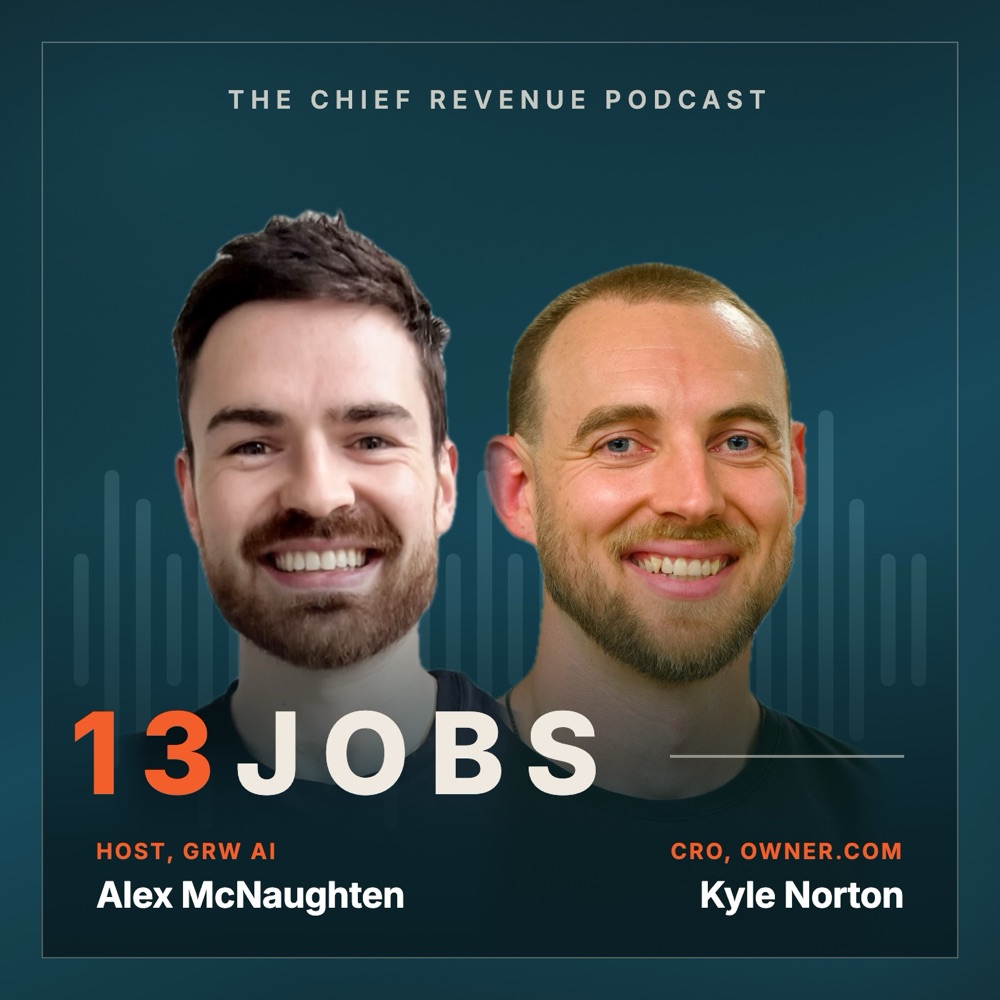
The revenue leadership framework
Kyle's six-pillar system for building sales managers, and why coaching is the pillar that pays for itself.
 Hosted by Alex McNaughten
Kyle Norton · CRO, Owner.com
As CRO for Owner.com, Kyle leads a team of world class go to market professionals who help independent restaurants grow their direct, online takeout and delivery channels. He currently owns the sales, partnerships, onboarding, success, support, revenue operations and enablement portfolios. Kyle leverages his 15+ years of experience in B2B SaaS sales, go-to-market strategy, and revenue leadership to provide value-added solutions for his clients and drive growth for his company.
He is also a Limited Partner (GTM Fund, Stage 2 Capital), Advisor, and Angel Investor for several SaaS-focused funds and startups, where he shares his insights and expertise on scaling, selling and servicing SaaS products.
Kyle is passionate about supporting the SaaS ecosystem and empowering entrepreneurs so he speaks frequently at conferences and on podcasts and webinars.
Additionally, Kyle is a founding member and Co-Chapter Head of the Toronto chapter of Pavilion, a global community of revenue leaders and operators.
In this episode, we discuss:
- 1.Why he builds a framework for everything, and why selling to SMB forces operational rigor
- 2.Write the first version badly: put it on paper before things start breaking
- 3.The six jobs of a sales manager: sell, coach, hire, build, operate, inspire
- 4.Where new managers are weakest, and why sellers make weak operators
- 5.Why sales breeds bad managers, and the DNA he screens for instead
- 6.The honest conversation about earning more as an IC than as a manager
- 7.Why coaching is the pillar worth the most investment
- 8.What bad coaching looks like, and the principles behind good coaching
- 9.Why coaching gets its own meeting, separate from the one-on-one
- 10.The forgetting curve, and why reinforcement is the whole game
- 11.The NFL tape analogy: chunking skills instead of reviewing whole calls
- 12.Finding the reverse salient: how to decide what to coach first
- 13.Hiring on a scorecard instead of vibes, and beating halo and horns
Quote of the show
“There should never be a time where you as a manager listen to a call front to back for a rep. Like, there's no point. What are you trying to achieve there? If you're coaching a rep on discovery, then I watch the 10 minutes of discovery across 7 different calls.”
Key takeaways
- Write the framework before you need it. By the time you feel the absence of a system it is too late and you are digging out of a hole. A bad first draft on paper beats nothing on paper.
- A sales manager has six jobs. Sell, coach, hire, build, operate, inspire. Promote and onboard against all six rather than assuming a strong seller covers them.
- Coaching is the pillar with the highest return. Assume you promoted a good seller; what turns their craft into everybody else's number is coaching, so that is where the attribute points go.
- Never coach a whole call. Pick one skill and watch the same ten minutes across seven calls. Feedback on discovery, value and close all at once is feedback nobody can act on.
- Coaching is questions, not telling. The manager is a Sherpa: nudge just enough to let the rep reach the answer, because the skill gets built where the struggle happens.
- Reinforcement beats the forgetting curve. A quarter is gone in two hours, half in a day, and only 20% survives to day 30 — which is why one theme runs for two to three weeks.
- Hire on a scorecard, not vibes. You are recruiting from a pool of charismatic people, so halo and horns run rampant. Score each trait with specific questions and fill them in one by one.
Transcript
Kyle, good to have you on the show. Thanks for coming on. How are you?
Doing well, thanks. Slightly under the weather, so apologies to the listeners for the stuffy tones, but other than that, excited to dive in and appreciate the invite.
So for those who don't know Kyle, Kyle Norton is the CRO of Ownr.com. But Kyle, tell us a little bit about who you are and how you came to be.
Yeah, so Canadian native, And I'm currently the CRO for Owner.com. We're like a Series B, $20 million plus ARR restaurant tech business. So you can think of us like Shopify plus HubSpot for the little tiny restaurants that you order from on a Friday night. So takeout and delivery heavy concepts. And we do everything from their website, online ordering, email, text message marketing, custom branded app, loyalty, all wrapped up in a package done.
For the restaurant owner, for the outcome of making more money. You know, these are really tough businesses to run and they're getting crushed by, you know, the big chains and the third-party delivery apps. And so we help them fight back and stay alive and thrive. So been here for a little over 2 years.
Previous to that, I spent 3 years at Shopify. I had a couple different roles. My last one was running the Canadian market, which was about a quarter billion dollar business unit across sales through customer success, partnerships, sort of everything nested under that. And then I was a startup VP sales for 3 years before that at a company called League from zero ARR to about $25 million.
And then it was boiler room, boiler room before that.
And look, we've known each other for about a year and I've been following what you've been doing with owner.com, which sort of brings me onto our topic because I've seen you scale that very quickly and really build like what certainly from the outside looks like a really like oil, well-oiled machine. And, you know, our topic today is your leadership framework and really how to think about your role, you know, for the listeners as a sales leader.
So yeah, where's the best place to start on this, Kyle? I'm curious to pick your brain on this one.
Yeah. So why don't I zoom out a little bit and just sort of put the, put this leadership framework into context and sort of jumping off of your comment like, oh, it seems like owner is a well-oiled machine. We have put a lot of focus and time and money and energy into building scalable systems.
We sell to SMB, so you need to be able to hire and ramp and scale reps. You need to be able to really predictably grow your business and have depth of understanding of the data to be able to operate a business like this because they're inherently higher churn, lower margin. And so it's an operator's business.
I've run enterprise teams and I've taken the same operational rigor there. I think it's just generally a competitive advantage, but just to survive in SMB, it's important. And so the reason I built this leadership framework in addition to a framework for just about anything I can think of is like having those structures in place enables you to find predictability and repeatability in either generating pipeline and converting it and activating it or hiring and ramping reps.
So I've got like a very robust hiring framework with a scorecard and specific sets of questions. And that has to flow through to every part of your business if you want to scale aggressively. Like we're, you know, there's so much talk in our market today about, you know, profitable, efficient growth and, you know, like just take one round and then let that be your last.
We're playing a more traditional venture-backed game where we've raised quite a bit of money. We are like foot to the floor in terms of growth and we're trying to win the market. Like we're not trying to like take a little niche, like we want to go win. And so to be able to do that and scale from, you know, we've gone from, my team's gone from 5 to 100 people in 26 months.
To be able to do that, like you need structure. You need artifacts and systems that can help people be successful so that they're not reliant on a person. Like many companies, you know, the manager will teach the new rep and the VP of sales onboards the new manager. And it's very much hand-to-hand combat, but it's too single-threaded on the individual.
And you can't onboard, you know, 4 reps in a quarter if you're individually doing so much of that. So like systems is a really big focus of mine.
Mm-hmm.
And today we can unpack the leadership system, which is how we've been able to onboard and ramp managers and second and third line leaders with a lot of effectiveness and efficiency.
Yeah, I think what you just said there about hand-to-hand combat is often how sales teams sort of just, they sort of organically grow where people will hire a couple of AEs and some of them do okay. And then suddenly you've got 10, 20 AEs all running their own playbooks, running things completely differently, and it just becomes impossible to get consistency and scale doing it that way.
So that's, I really resonate with your approach and how you do it. So where do we start?
The challenge there is by the time you realize you need a bunch of systems and structure, it's too late. And then you're like digging out of a massive hole. And so, you know, feedback I give to earlier-stage revenue leaders early is like, just put something on paper because it's going to suck. Like, the first version of it's not going to be very good.
My documents weren't very good. It's just a sketch of a bunch of thoughts bullet pointed out and like, okay, here's your demo framework, here's your coaching framework. And over time it can get better, but you need to just get things on a page or else things just start breaking. And, you know, interestingly for owner, you know, as we've accelerated growth, we're actually growing faster today than we were at the end of last year.
Things are not breaking. Things are actually getting better because, you know, we've done the work to put in the infrastructure.
So what does that look like? You know, new sales leader, what does that work look like? Where do we start?
Yeah. So I'll go through the 6 pillars and then we can talk about how that comes out sort of day to day. And I'm onboarding a manager, an external manager and a new BDR director on Monday. So, we're actually doing this as we speak in terms of translating framework into onboarding. So, there are 6 pieces, like 6 components, 6 jobs to be done to be a sales manager.
First is sell. You need to be able to sell the product and get on a call with a rep and get the job done. I don't believe in managers that are just like dashboard jockeys and coaches. Like, you have to, with some, with a high degree of competence, actually get in there and like do the job.
Yep.
You don't have to be the very, very best rep. Oftentimes the very best rep isn't the best manager, but you need to be in like a top 20% seller and have good craft because you need to be able to break down that craft and explain it to others and help them get the job done.
So, Sell is number one. Coach is number two. Can you translate your ability to sell into somebody else's ability to sell? And so coaching is like very counterintuitive. And oftentimes coaching is just like a manager telling the rep what to do different next time. And like, that's not coaching. KD, Kevin Dorsey had a great post on this today, the difference between like coaching and telling.
Mm-hmm.
So can you coach? And we can break some of that down. 3 is hire. Can you systematically identify great talent, select the right people? We're all going to make mistakes. You cannot be perfect at it. But like, can you move the probabilities of success in hiring by being like structured and systematic and being a great listener?
Build is the other— is the next pillar. Can you identify a problem in your business and fix it. And this is much more relevant for startup managers. You know, if you're a manager in a business that has like 10 other managers, you might not be building as much or you might be building things that are more relevant for just your team.
But this 6-piece framework applies to directors as well. So, the build as a manager might be smaller, but the build as a director is much, much greater. Then operate is number 5. How do you operate your team day to day? How do you drive the results that you want to drive? How do you get projects done?
How do you deliver the number? And that's about like your weekly rhythms, the reporting cadence, the meetings that you run. How do you keep people on track and accountable, managing to your math of sales? And then the 6th pillar is inspire. Can you drive a highly engaged team through I mean, there's a lot to unpack there, but can you attach them to the mission, give them a sense of purpose, help them find mastery in their job, make them feel like recognized and rewarded?
Daniel Pink's framework is good here, like AMP from Drive, autonomy, mastery, purpose.
Yeah.
And so, can you— it's not the rah-rah speech in inspire, but can you make people feel engaged in the work and excited to come in every day and giving it their best. So, sell, coach, hire, operate, build, inspire.
Is there, do you find that leaders typically have some of, like, some of this down and that you're having to teach the rest? Where are most people weaker?
So, salespeople tend to be weak operators. Because your job is to, you know, get on a call and influence, persuade, execute your sales craft. But like entering notes in Salesforce and keeping a clean calendar and like time blocking themselves, these are not skills that oftentimes come naturally to the types of people that are attracted to a sales career.
I try to pull the people, I try to pull the reps into management that are naturally good operators because it's, you can be successful as a rep without great operational rigor. If you're just, you know, if you're an awesome crafter, if you're great at sales, you can get around it. But like you that's not possible as a manager.
So I would say like, that's a piece. Nobody is good at hiring out of the gates because it is really counterintuitive. And so there's a lot of unlearning that needs to get done, but I don't expect them to be good at hiring. Like, I'm happy to teach that. And coaching similarly, like, people tend to be pretty deficient because—.
Mm-hmm.
You know, you're used to as a seller showing up and talking and, and like convincing. And so we think coaching is convincing or coaching is telling. And so you have to unlearn a lot and learn to be a Sherpa, as we call it internally, like to guide somebody, but like let them go through the work, let them go through the suffering, let them, let them build the, the mind, like have the myelination happen to learn those new skills.
So, I mean, I think like, I think sales naturally breeds like pretty bad managers because you have to be so selfish as a sales rep, so inwardly focused. And so I just want to see the right DNA and I feel like I can teach the rest. But you have to have good craft and you have to have an interest in coaching.
I think this is the biggest piece. The thing that I really heavily screen for, especially when I'm thinking internal promotions.
Yeah.
Because everybody wants to be a manager because you're like, yeah, I want to be the boss. I want to get promoted. But then they don't think like, oh, do I actually want to do that job? I don't really like updating Salesforce and I'm easily frustrated by like bureaucratic stuff. And you're like, okay, well, that's like all the job of a manager.
So I don't know, like, I know you want to get promoted, but like maybe you don't want to do this. And so I'm really looking for people who are naturally operationally oriented so that it's a little easier to teach them that and people who want to coach because if you're a talented seller, things oftentimes come naturally to you.
Yeah.
And then when you're teaching somebody else and they like don't get it right away, you're like, I don't know, like this person's just not getting it. And so, I want to— part of the process by which I help people explore if a management career is right for them is I give them a bunch of coaching opportunities.
Yeah.
And I give them a rep to mentor and buddy. And I'll talk to them and like get their experience. And if they're, you know, they'll quickly understand if they get frustrated by it or if they're like, and then he applied it on the next call and the guy said yes. And then like, if you see that like excitement and that magic of seeing somebody else do a thing you helped them do, that's when I know it's like, okay, I've got the right, I've got the right raw building blocks there for this person to be a manager.
And I still have to like, they have to unlearn a bunch of stuff and I have to teach them from scratch. But that's what I want to see.
Yeah, it's really interesting going back to what you said about sales sort of naturally breeding quite poor managers because of the selfish nature of what selling is or the orientation Selfish may be the wrong word, but it's a self-orientation to be in sales more so.
You can call it selfish. Like, I went into sales because I wanted to get paid for my success.
Yes.
I went to a good business school here, had a bunch of options. I was like, man, but I'm just gonna like do this job. And if I do really, really well, I get promoted in 2 and a half years instead of 3 years. And then I go to this next thing and this next thing.
But for sales, You know, it's like, oh, I can make as much money as I produce and I can get promoted as fast as I can show I'm good at this. So it is sort of a selfish, very inwardly focused profession, you know, versus CS. I think managers more naturally come out of that function because they're so outwardly focused.
They're focused on enabling others to be successful, which is really the orientation you need as a good manager.
And sometimes the best thing for salespeople who are that way inclined is actually just to keep selling and move into different sales roles because—.
Absolutely.
One thing, and I've, you know, mentored a few, like, a few people over the years in this, and you can often earn more as an individual contributor in sales without all of the bureaucracy of management.
Yeah.
And if you're that way inclined, actually, that can be a really good path for you. Rather than going into leadership. And it's interesting how you try and identify the tendencies for management. I really like the coaching example you gave there of how you, you know, see if someone gets lit up when they help someone else figure something out.
That's a really interesting and good signal that, yeah, okay, that's gonna inspire them and motivate them across the team.
Yeah. Yeah. And I have pretty honest conversations about this with folks. You know, people who are like, yeah, I want to manage a team. And I know it's like not for them.
Mm-hmm.
I'll be pretty transparent and have this conversation. It's like, look, like, you know, I know everybody wants a promotion, but like, you're talking about becoming a BDR manager and making $50K less than you're making today. And like, you're always the rep that we're bugging about Salesforce updating, like 40% of your job is making sure like Salesforce is good and you're on other people's case.
And so, so it's important to just have that transparent conversation with people. And I think people do come to understand that, like what the right path is. The other piece of that is we need to make sure that we continue to elevate the senior seller. And so, you know, the 2 most senior sellers on my team, They are like just as important as any of the managers, you know, like I spend a bunch of time with them.
I want to hear their insights about what they're hearing from customers. We make sure that they're like well recognized, well paid so that, you know, they don't feel a pressure to go down a path to try to like make more money or be seen as more important. Like we try to make sure that that individual contributor track.
Is just as valued as anything because one, that's like how you should manage a team. You know, to like, you've got to recognize people and that needs to be a big part of your engagement strategy. But it also then like keeps this equity and removes the pressure from like, oh, I got to do the next role and the next role and the next role.
Like even I gave a director title to like my top rep a couple companies ago.
Right.
You know, it's like, dude, you're making crazy impact. You closed like an insane portion of revenue that the whole company closed. Like, yeah, you're like director importance.
Yeah.
You know, you might not be like, it might not be the right fit for you to manage people. But like, you're important. And I want you in like strategy meetings when we're talking product. And I want, you know, you can find, you can find ways to make both of those paths you know, really attractive for the right types of people.
Yeah, I liked how you talked about coaching as being a Sherpa, and I'd love for you to expand on that a little bit because I hear the word coaching thrown around a lot, and a lot of the time it's sort of not actually coaching as what people are describing. So I'd love to get your definition on it and like, what does great coaching look like for you and your team?
Yeah. So, I would argue that this is the single most important of those pillars to invest in. Because I'm just going to assume that you've promoted a good seller into this role. And then the next thing that drives the most results, like if you were building your, like, NBA 2K player and you were assigning, you know, attribute points, like you would assign a lot of attribute points to coaching.
Um, so there's a couple of really key principles there. One is I believe like really great coaching requires a lot of focus.
Yep.
So like bad coaching is we listen to a call and I give you feedback on the discovery and then feedback on how you presented the value statement and then feedback on how you closed. You can't do anything with that. Like you need to focus on just one thing at a time. That's how people are able to learn.
And there's a book called The Talent Code that a lot of this comes out of by Daniel Coyle. But like, great coaching requires a ton of focus. So that's number one. Great coaching is questions-based. This comes from The Coaching Habit by Michael Bungie Stanger. So you're using questions to help the rep explore and sort of coach themselves.
Yeah.
And only providing enough input to nudge them to the right answer. Because where they struggle, like where we build skill and the the process in the brain is called myelination. Where the myelination happens is where like effort and struggle happens. Huberman talks about this a lot too. So great coaching is questions-based because you're trying to help them like get to them, get to it themselves.
And then great coaching is built around deep practice. That's like one of the other really important things. Like, again, if I give you feedback on 3 different things and I'm like, okay, so Alex, like next time instead of saying this, just say this.
Yeah.
Okay, go for it. Like, you haven't learned anything. You don't learn anything by just being told. It's like, okay, so Alex, we're gonna work— like, let's just work on how you set up the call, you know? Like, we're just gonna work on your call setup. So like, do it again, but like, I want you to add this.
And then you do it, and then I give you feedback, and then I ask you to do it again, and then feedback again, feedback. And we go through like 10, 15 repetitions of just this one thing, and it's we call it an isolation drill. I'm isolating one thing and I'm trying to get into this like deep practice territory.
Yeah.
Now when we've done this thing 15, 20 times, now I say, okay, go try this on a call. I, I've actually built some, some like muscle memory around doing this new thing. So, um, coaching has to be like built around deep practice, and we can talk about a bunch of stuff there. And then the last piece is it got to great coaching has to come from a place of caring.
Like, you have to care as a coach. There's the, like, I think Teddy Roosevelt saying, people don't know how— people don't care how much you know until they know how much you care.
Yes.
I might be butchering that quote, but like, you have to be excited to coach. You have to be able to show them that they're in a like a safe environment to make mistakes and like you legitimately like want them to get better and coaching is not like a management— coaching is not a management action.
It is separate. Like there's in that framework, there is operate, which is managing, and then there is coach. Those are separate disciplines and considered separately. So I don't let my— I don't allow my managers to coach in their one-on-ones.
Interesting.
You have a separate coaching meeting because as soon as you coach in your one-on-ones, then they get conflated and then you run over time and then the coaching doesn't happen and coaching feels like management and you've lost it. But like instead it's coaching is about, coaching is about like just doing that and caring.
Mm-hmm.
And then the last piece is like reinforcement. Like really great coaching requires reinforcement because there's this thing called the forgetting curve. If I teach you something in, I can't remember all the times, but in like 2 hours, you've lost 25%. In 24 hours, you've lost 50%. And by the time you've— you're at day 30, you only retain 20% of the thing that you, you were taught.
Yeah.
And so, the reinforcement— this is part of like why we focus on one thing for sort of 2 weeks or 3 weeks at a time. But the reinforcement is the key. It's called like expert feedback. Because you're battling the forgetting curve. So, I've forgotten a bunch, but then I do a reinforcement thing 24 hours later.
Okay. I'm like now back up to where I was. And then I'm forgetting a little bit more, and then we have another coaching section the next, next week on the same topic. Or you've sent me a call where you're doing this well in a, in a couple days. Like, that's a reinforcement moment.
And then that's how you battle the forgetting curve. And eventually that thing sticks and goes from unconsciously incompetent to now being unconsciously competent because I've just done so many repetitions. Now we move on to the next thing. So, so Those are the big things. Focus, it's got to be questions-based, built around deep practice.
That's probably one we can dig into. Caring is a big piece of it. And then repetition. Great coaching requires repetition to fight the forgetting curve.
It's clear that you really value this and have thought about it in so much more depth than most sales leaders. And I'm curious, when did you become of the opinion that coaching is the most important part of this framework?
I think actually before I got into sales.
Okay.
So a lot of what's informed my approach to coaching is I've just like taught things a lot of my life. Like even Uh, like, I almost went to fine arts school, actually. And so I was like a fine arts student my whole high school career. And in the summers, I taught preschool art.
Right.
I wanted to do anything art related. So I taught preschool art, and then I taught like different sports I was playing. And then I got into mixed martial arts and started coaching, um, jiu-jitsu and, and, uh, some other stuff after a couple years. And I just saw the delta between like really good coaching and not so good coaching.
Hmm.
And the guy that like really just blew my mind on it was this guy Matt Thornton who founded Straight Blast Gym. And there was just so many crazy talents coming out of this gym that was new. It was like a new American academy. And yet they, you know, that's where Conor McGregor came from.
Um, there was like this Icelandic guy that came out of nowhere and was like winning the biggest tournaments. And it was like Like, it was really insane. And then you read that— then I read The Talent Code years later, and I connected the 2 things. But I got to see like isolation drills that's straight out of the Straight Blast, like Matt Thornton playbook.
Yeah, yeah.
And everybody in jiu-jitsu, like, you want to learn something, it's like, okay, let's spar. Like, practice is just sparring because sparring is really fun. You're just like, you know, you're getting in and rolling. And, but you don't really learn that much. Like where you really learn is doing the super boring 30 minutes with your partner and be like, we're just gonna rep out, we're gonna rep out this like one counter.
You do this, I'm gonna like, I'm gonna try to like do this other thing. And then you're going to like increasingly make that more difficult. And I just saw how much faster I started to learn when I just did like drills and drills and drills. And so when I came into teaching sales, it was just like, oh, I should just sort of apply the same stuff that I saw work so drastically different with Straight Blast versus other gyms to this.
And then I read Talent Code, and then it all made sense because Daniel Coyle does this like big study of why there's these like, I can't remember the word, like talent hotbeds, these like, these places that just generate way more successful people than than should. Like, there's a tiny Russian tennis school that produced more top 10 tennis players than, like, all of the US combined.
Mm-hmm.
Well, what's with that? What's with this, like, Brazilian soccer academy that produced all of these crazy athletes? And so, he breaks it down and it's, like, chunking, sequencing, deep practice, and, like, explains the neuroscience, the myelination behind it. And so I actually came in with an advantage having like this in the back of my mind.
So I've spent a lot of time like reading about it, thinking about it, studied adult learning principles a couple of years ago. Because I just believe it's the single most important thing you can do as a sales org is just like become a talent factory.
Well, You know, I'm of the opinion that great expert one-on-one coaching does more for performance, but also someone's life outcomes than just about anything else. And I think that—.
For sure.
It's really interesting how most sales orgs don't go to the level of depth and put as much importance on coaching. Despite the fact that we know, like, if you think of like the sports analogy is such a good one because like you wouldn't dream of being a professional athlete without regular coaching, without practice, without all the things you just talked about.
Yeah.
And yet we, too many sales organizations have a very laissez-faire approach to sales and sales performance and then wonder why we're not hitting quota. And I'm just, it's really interesting.
This is, this is the equivalent of what most sales organizations do. Imagine an NFL team. They get together on Monday and they watch a bunch of tape. And then the coach is like, oh, actually you should be here. You should be here. And like, don't do it this way. They're like, awesome. Let's go play a game.
That's basically what we do. We like, you know, we tell the rep a bunch of stuff. We like watch the game tape. We tell the rep some stuff and then we say, go do it on the practice field. No, the, the, Those practices are broken down into like the discrete skills, which Daniel Coyle would call chunking.
So like, how do you chunk down to the smallest blocks of things? We're just going to practice tackling. We're just going to practice how to shed blocks. We're just going to practice like this one thing.
Mm-hmm.
And then they practice those things in discrete chunks in the right sequence, and then they put them all together to try to have that work on game day. So like, one of the coaching principles around focus is like, we never coach an entire call. There should never be a time where you as a manager listen to a call front to back for a rep.
Like, there's no point. What are you trying to achieve there? If you're coaching a rep on discovery, then I watch the 10 minutes of discovery across 7 different calls.
Yeah.
And then I have like one theme Okay, I'm gonna— we're just gonna— like, we just want to talk. We just want to get better at asking second-level questions.
Mm-hmm.
So you're asking good— you're like using the discovery checklist, but the customer says this, and I want you to ask the next thing and the next thing. You could call it like Sandler's 3 levels of pain or whatever framework, but like get, get deeper. And so then I'll take 6 calls and be like, okay, So let's listen to what Alex says here.
Okay, and pause. What's the next question you could ask? And they're like, I don't know. You're like, take your time, like think about it. And then let them struggle, let them think it through. And what I'm trying to do is I'm trying to compress the time from the trigger, the thing that I need them to recognize, from trigger to recognition to the application of the skill.
Yeah.
Because at first they'll listen to it and they need to sit there and think for like 3 full minutes. I should have asked them how they've thought about addressing that problem currently. And you're like, okay, good. And then you play the next clip. Okay. And like, what now? And so it might take them 3 minutes to struggle through it and you give them some coaching and feedback and then you listen to a couple more and now they like, oh, it's a pause.
You know, it takes them 20 seconds, but then they get to the question and you just do, you could do like 30 of these repetitions. Just play something the customer said, what's the question under a layer under you can ask instead of going to the next topic? And then eventually, they're just ripping them out.
And so, that isolation, those isolation drills, that deep practice on that one topic. The topic is not discovery. The topic is just asking the reflective question. And you go through 30 of those examples and then now send somebody out into the wild and they'll be able to perform that. That is like that principle of depth.
How do you decide what to focus on? What is informing that?
So, that is the sequencing part of that talent code model. The other term that I like there is like what's the reverse salient? What is the biggest blocker between you and success? And so, If you— the silly analogy here is like, if you wanted to teach a monkey to juggle flaming chainsaws on top of a pedestal, where would you start?
And a lot of people are like, well, let's get a quick win. Let's build the pedestal. Well, like, that's irrelevant. Like, it doesn't— you don't need to build the pedestal unless you can get this monkey to juggle. And so, like, that's the most important thing. Like, none of the other stuff matters unless this stuff And is good.
And sales is sequential. I can't ask for a deal unless I demonstrated value, and I can't demonstrate value until I can understand pain. And so, you can work back and understand, like, all right, well, if at the very top of the funnel, I can just get you to have more highly engaged conversations, learn about business challenges, then the demo gets better, then the ask gets better, the next step gets better.
But this is your job as a coach is to diagnose. And you're diving into the data. You're like contrasting that with other reps. You know, we've taken some like very data-driven approaches to it to like actually measure skill performance versus outcome. Like we measured with replays like their capabilities on all these scores and how the capabilities related to quota attainment.
Like, okay, these are the skills that matter. And then we worked on those. But yeah, you can get to that answer a few different ways.
I'm conscious of time and I could talk to you about this all day. And we've sort of done a bit of a deep dive on the coaching piece, which I had a feeling we might do as we're both quite passionate about that area. Is there anything else? Actually, maybe one question I'd like to ask you actually is on the hiring side before we wrap is a quick question on, you said that most people have to unlearn a bunch of stuff when they're hiring salespeople.
What are they doing wrong and what, yeah, what's your philosophy around it?
Yeah. So What most people get wrong is they don't have a system and they're very like— they don't have a system and they just like show up to a call and ask some random questions and then like make an assessment.
Hmm.
And so they don't have a scorecard broken down across every trait. And then based on the scorecard, having specific questions that will give you the answers to the things on that scorecard. And so, I think it's just like a lack of system is oftentimes a problem. It's like, okay, so we've got like a 3-component scorecard.
What's their DNA? How good is their craft? And do they have specialized knowledge? And so, under DNA, it's like, mindset, habits, intelligence, character.
Right.
And it's like, okay, so under mindset, how do we, how do we judge drive? And so we don't, and oftentimes people will like spend 80% of the interview just trying to assess drive and resilience. But really you need like 2 or 3 questions there to like really get at the heart of it.
And then how do I understand, do they have discipline? Like walk me through your day. Tell me about a day in the life of Alex and like just from the time you wake up. And there's different ways to like understand, is somebody disciplined? Are they a learner? Do they like learning? Are they good at learning?
Do they have a passion for it? And so just by laying out your like really specific scorecard and then ensuring that the questions you ask across 3 or 4 different interviews give you the information you need. To like answer those scorecard questions. That I think is probably the biggest mistake that people make because in the recruiter screen, I just want like 3 things.
It's like, I just want history of excellence. I just want to get an assessment of drive. And then I can't remember what's exactly there. And then the hiring manager is like, maybe is also clicking into one of those, but they're really now getting into coachability, curiosity, the super learner stuff. And then the craft is all in the case study.
And then Brett and I, my VP sales and I, will meet all of the finalists and like we're doing like a final check normally on like the mindset stuff.
Gotcha.
Do you have rugged flexibility, we call it, which is borrowed from Brad Stolberg's book, Master of Change? Like, is this person ruggedly flexible? When things get hard, are they going to recover? Do they have, you know, the grit and determination resilience to move through things? And so By laying those all out and being thoughtful about like, we get these things here, we get these things here, and like maybe Brett and Kyle double-check some of the most important ones that we should have already touched on, then you use those interview minutes much better than like a meandering conversation about like all sorts of random stuff.
Yeah.
That's, I think, how you can take a lot of risk out of it. Because otherwise, just like cognitive bias runs rampant. Like halo and horns effect. So, if somebody's super charismatic, we assume that they're like really smart and really curious. But like they didn't ask a single question.
Yeah.
But like charisma has a halo effect. Or if they're a certain way, like oftentimes the horns effect is it can have a negative impact on how we view other things. And so by being like structured, by being structured in the approach and really diligent, you can put as many of those cognitive biases to bed.
Yeah.
Systems are key. And I think so many sales leaders hire on vibes. And—.
This is the hardest thing.
Yeah.
Because you're naturally you're pulling from a talent pool. You're pulling from a talent pool of charismatic, good vibes type people. And so it's really easy for that to color everything. But when you scorecard, and there is a part of the scorecard for like charisma, like, you know, how do you communicate? Do you like build an authentic rapport?
That's part of it. That's part of selling.
Totally.
But like, how prepared were they? How much agency did you find from them? And by having that on the scorecard and forcing people to go in and fill them one by one, You're like, oh yeah, this guy was awesome and this girl was awesome. And I really liked them because like we played the same sports or we grew up in the same town.
But then you start to unpack it and go line by line. Oh, actually they weren't that high agency. Oh, they weren't very curious or they didn't have good examples of coachability. It just gives you the— it is a system or structure outside of your own brain that will help you do your job better.
And the talk I gave at SaaStr a couple of weeks ago, the analogy I used through the whole thing is like, this is your revenue operating system is like your Iron Man suit. And so, all of these things are like, okay, I've got my scorecard that is like my Iron Man gloves. And I've got my Iron Man like arm piece, which is the interview guide with all the questions laid out.
Yes.
And so, the more things you can take out of your brain and put onto a piece of paper so that it's something you can reference and other people can reference, the better your results will be. Because now you're not reliant on the— just like you're not reliant on you just remembering to do it the right way every time or somebody else remembering to do it the right way.
There's some other prompt or structure. That's when you find way more repeatability.
Kyle, we've gone way over, but this has been an awesome conversation. So apologies for going a bit over. But Just to wrap things up, where can people find you if they want to? Because you put out a bunch of killer content. So where's the best place people can find you? And, you know, whether they want to connect or just learn from you.
Yeah, LinkedIn, you can find everything. And then I just launched a new podcast with the fine folks at Topline called the Revenue Leadership Podcast. So if this is a topic you're interested in, then that podcast will definitely be for you and First guest was Jason Lemkin. Katie's up next. Denny Mehta from Lattice is coming on.
Mark Roberge. So it's like a, it's a monster lineup and it's just me ranting and raving with other revenue leaders about this type of stuff. And we, much like today, we try to take one topic and go really deep. So that's all the major podcast platforms. There's, I got a Substack going, which is just the Revenue Leadership Podcast.
Substack.therevenueleadershippodcast where a bunch of this stuff lives.
Awesome. Kyle, thank you for coming on the show. I really enjoyed this conversation.
No worries. Thanks for having me.