
What's old is new again
The golden age of tech sales let teams skip the fundamentals. John on what has to come back, and what AI does to reps who never learned them.
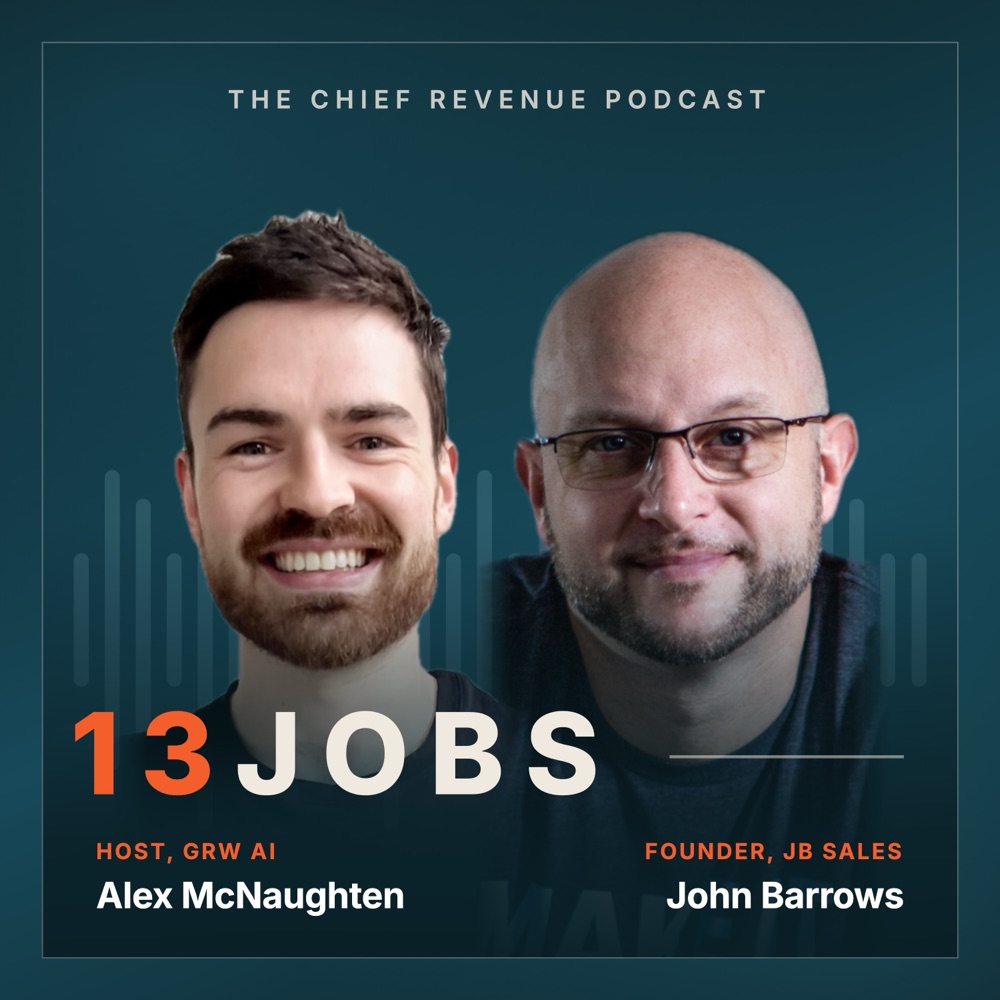
 Hosted by Alex McNaughten
John Barrows · Founder, JB Sales
With over 25 years in the sales industry, John Barrows has held various positions, ranging from making 400 calls a week to serving as the VP of Sales at a self-funded startup that was acquired by Staples.
Now, he leads JB Sales, a training company that collaborates with top organizations such as Salesforce, LinkedIn, Amazon, and Google, as well as many of the world's fastest-growing companies. His extensive experience has provided them with deep insights into the effective strategies and common pitfalls in sales and has trained over 100,000 sellers!
Committed to continuous learning and improvement, he aims to use his knowledge to uplift sales professionals and enhance the field itself, believing that when executed proficiently, sales is the most rewarding profession.
In this episode, we discuss:
- 1.Why 2010 to 2022 was the golden age, and why selling wasn't actually hard
- 2.The playbook that worked anyway: template blasts, cadences, demos for anyone with a pulse
- 3.Why role segmentation was built for our growth, not the customer
- 4.What happens when money stops being free and nobody learned the fundamentals
- 5.Not replaced by AI — replaced by reps who learn to use AI
- 6.Taking his head out of SaaS, and what the rest of the market actually looks like
- 7.Why everybody needs to slow down
- 8.Business acumen on steroids: how he preps an industry, a persona and a 10-K
- 9.Why AI email still reads soulless, and what that costs you
- 10.Why you have to believe in what you sell to last
- 11.The first month of a sales career should have zero product knowledge in it
- 12.Chasing bad-fit revenue, and the one G2 review that undoes it
- 13.Playing the long game, and Sinek's infinite game
Quote of the show
“I think the first month of a sales professional's career should have zero to do with product knowledge. Zero. I think the first month they should meet with the top 10 customers and have a conversation with them about why they bought.”
Key takeaways
- The golden age hid the gaps. Free money, template blasts and demos for anyone with a pulse. The playbook worked well enough that a generation of sellers never had to learn the fundamentals.
- We over-engineered the process ourselves. Segmenting SDR, AE and CS was great for growth and never customer-centric. Nobody wants to be handed off five times before reaching someone who understands their problem.
- AI won't replace reps, but reps who use AI will. John's blunt read is that only a small portion of the population makes that transition, and the rest get squeezed out.
- Business acumen is the cheapest win available. Industry trends, what that persona cares about, and the two things that matter in a 10-K, all in minutes. What used to take a week of prep is now table stakes.
- Buyers can tell when an email has no soul. AI outbound is better written than the cadences it replaced and still reads as pattern. If the buyer can tell you don't care, they don't care either.
- Start new reps with customers, not product. Month one: the top ten customers on why they bought, and the founders on why they built it. Product knowledge can wait.
- Bad-fit revenue costs more than it pays. Average work for a customer you should never have chased turns into one G2 review or one LinkedIn post, and that outlasts the deal.
Transcript
John, good to have you on the show.
Hey Alex, good to see you again, man. Thanks for having me.
For those who don't know John, seller, then sales leader and now founder who's been supporting the sales function for over a decade and you've trained over 100,000 sales professionals. That's a lot of sales professionals. But John, for those who don't know you, tell us about yourself.
Yeah, so appreciate it. Yeah, I've been in the game for a little bit too long at this point. I think 28 years selling at this point, still selling every day. But yeah, I mean, simple. I fell into sales just like everybody else. You know, I got my degree in marketing and then kind of fell in.
I didn't like the opportunities there. So DeWalt was first job. Xerox was the second job. That's where I kind of really got my full sales education selling copiers to the government, which is about as brutal as it gets. And then, but I will say that's where I got my sales education, like learning how to sell copiers.
And back in the day, you know, Xerox actually did Uh, they created solution selling back in like the late '70s, early '80s. So they had such an incredible, uh, looking back on it, I didn't, I kind of discounted that training because I was like, yeah, yeah, whatever. But now it was a solid foundation for where I am today.
Then started a company called Thrive Networks doing outsourced IT support to the SMB market. I was 25, didn't know what I was doing, took every training I could, came across Basho, this company that was local in Boston, loved it. Um, used it, grew Thrive, fastest growing company in Massachusetts for a couple years, self-funded, and then Staples bought us.
Uh, then I got fired from Staples because I'm not a corporate guy. Uh, and, uh, well, they offered me another position, they fired me. And, um, and then I, I, you know, I was looking for a job and Basho, the training company, said, John, you want to be a trainer? I was like, absolutely not.
They're like, why not? I'm like, I don't like trainers. And the reason was because up until that point in my career, uh, you know, the only type of sales trainers I had ever come across were either failed sales professionals or professional presenters. And, and I didn't wanna be that guy. And so they said, don't worry, you have to use these techniques to sell so you can train so you can get paid.
So I like that because it was like practice what you preach. So I joined them, took over some bigger accounts, brought on some bigger ones. To make a very long story short, they screwed it up and I took it over. So I went off on my own about 15 years ago, JV Sales.
And now I work with companies like Salesforce, LinkedIn, Box, Amazon, Google, and a lot of the SaaS companies to train their sales organizations how to execute and stay relevant in today's Pretty crazy world right now.
Yeah, and it is a crazy world. And, um, before we started recording, we were talking about this idea of what's new— sorry, what's old is new again in, in the world of sales. And I think, I think this is an interesting topic, uh, and I'd love to unpack that one with you. So when you said that to me off, like, off camera, like, what did you mean?
What's old is new again?
I mean, look, I, I, I'm positioning 2010 to 2022 as golden age of sales, right? If you— especially tech sales, if you got I did tech sales after 2010 and I'm sorry, I don't wanna offend anybody, but I will. I'm sorry, sales just wasn't that hard for the past 10 years.
That was me. Yeah.
Right?
Yeah.
So, I mean, you know, right? I mean, we got away with blasting out template emails, like we over-engineered the sales process. We, you know, we got cadences going out crazy. We'll set up, you know, demo calls with anybody with a pulse, ask dumbass bank questions, drone through demos, let our SE do the majority of the work and then offer a massive discount.
Like that's basically been sales for the past 10 years. And, and through no fault of, you know, these kids, you know, when I say like the, those kids coming into the market like that, it's almost like the trophy generation. Everybody craps all over the trophy generation. Well, who gave them the trophies?
Yeah.
The parents did. Right? And it's the same thing with all these tools. Like, who over-engineered the sales process? We did. And so now we skip the fundamentals and we, we have this predictable revenue model that was all the segmentation of the roles, you know, SDR, BDR, AE, CS. And that was never customer-centric.
It wasn't. It was great for us to grow, right? With a grow at all costs when money was free and clients didn't matter. ROI wasn't really all that big of a thing. And so it, it worked in that model. It also worked when the SDR became your AE and stayed in your organization for 5, 6, 7 years.
Right?
Yeah.
But now the money isn't free. Sales is hard. We've skipped all the fundamentals. So now all these kids have no idea how to sell. And now that it's really hard, they're falling apart and the customer has zero tolerance anymore for our selling process.
Yeah.
Right? I mean, who wants to be handed off 5 times before they actually talk to somebody who knows what they wanna talk about? It's ridiculous. So it's all falling apart in our face. And then you throw AI on top of this and you have the, like, the perfect storm of sh*t happening right now.
Yeah.
And so when I say what's old is new again, we have to get back to fundamentals. We have to get back to relationships and, and giving a sh*t and, and, you know, quality over quantity while we figure out how to leverage this AI to put us in a position to, to make sure the human factor still stays involved.
So that's, I think, where we, we, it's almost like we were in this middle ground before where it was like, yeah, fundamentals didn't matter and the tech was cool, but whatever. Now we're You have to have the fundamentals and you have to learn the tech. There's no middle ground. Like we're not gonna get replaced.
People talk about sales reps getting replaced by AI. That's not gonna happen. Sales reps are gonna get replaced by other sales reps who learn how to use AI. That's what's going to happen. And that's gonna be unfortunately a very small portion of the sales population. So a very large portion is going to get wiped out in my opinion.
Yeah. Um, I, I really like how you framed it as the golden years of selling and, and I was someone who came up in the golden years of selling and, you know, I think back to some of the outreach approaches I did in a previous, you know, career life. God, you'd never do that today.
You wouldn't get away with it. We— no one would reply to you. You'd be told to f*ck off. Um, but that's, that's how I came up and it worked and it was pretty effective actually when you look at that, you know, when you looked at the results. Um, but, you know, that was propped up effectively by free money.
And now money's not free. And that, and it's remarkable to see how quickly that's flipped in terms of the effectiveness of what used to work really well. And I think something else—.
That's all independent of AI, by the way. Like, so that whole thing, like, you all, you take AI out of it and we're still in a mess. We're still in a brutal spot. You add AI on top of this, it's like, whoa, okay, there's no options anymore. Like, you have to evolve, you have to, or else you're just, Anybody who's got their head in the sand right now and not using AI, not figuring out how to leverage this stuff.
I mean, if you still got a job, good for you.
And the AI piece on this is interesting because here's my thesis on this is that short term, like every piece of technology, salespeople will ruin it.
Already have.
Yeah. And it's just gonna exacerbate the bad things we were doing. And it might take a minute before we learn, yeah, actually the fundamentals are important and let's, let's get back to that. What do you think needs to happen for businesses to actually, you know, because probably, and it was really prior to me coming into sales really is that I heard about all these training programs that the corporates would have and the bigger companies would have and they were good.
Like you talked about with, you know, in the, in the, in the Xerox and the printing industry. It's the same in the telco industry. It was a really, really well thought out, good training that was all kind of scrapped in a lot of these companies. What do you think needs to happen for organizations to go back to that, go back to the fundamentals?
It's tough, right? Because I always have to take my head out of SaaS every once in a while, right? Because I realize that, you know, I get freaked out with every, oh my God, and then you, you know, you take your head out of SaaS and tech and it's sales 1985 all over again.
So like a lot of the, a lot of the big corporate, they still have really well thought out, right? That type of thing. But in SaaS, it just moves so fast that I think they've abandoned it because, and it's more of like a transactional, like, okay, cool, whatever. But it kind of goes back to what I was saying as far as the predictable revenue model is concerned.
It made sense. The predictable revenue model of getting somebody, a kid right out of school, paying them, you know, you know, well, now they paid way more than I could possibly imagine.
Now they're on 6 figures straight away as an SDR.
Like, holy sh*t. But, you know, theoretically, you paid them relatively little, you beat the sh*t out of them, and then they become your AE and long-cycle sales, right? But now I think the average sales rep, at least in SaaS, stays in their company for like 14 months.
Yeah.
So all that investment in the training and in those, in, in those people Like, why? You know what I mean? Like, and it's just the corporations are faced with this double-edged sword, right? If they don't invest in their employees, then their employees leave. But if they do invest in their employees, then they leave.
And you know what I mean? They, they take that training and then they go get paid some more someplace else or whatever it might be. So it's a, I don't know. I think a lot of it has to come back to like sales reps just taking it upon themselves, quite frankly. To not wait for the organization to invest in some type of training because content and information is so readily available at this point.
You can learn anything about anything at any time right now. You want to learn Sandler? Go like you could. There's, there's 50 videos on Sandler on YouTube right now that you could go learn the upfront contract, pain funnel, and whatever else you want to learn. Medic, Google it. Ask ChatGPT, hey, how do I run a gap selling call, you know, with Jim Keenan?
Yeah.
Like that type of stuff. So I actually think it's, it, yes, you know, organizations should kind of take a more— well, look, let me put it this way. I think everybody needs to slow down.
Mm-hmm.
I think people just need to slow down. And that's why I'm kind of glad money isn't free anymore because it woke everybody up to, ooh, maybe this wasn't the right thing to do. Maybe we do need to hire more effectively, make sure we're hiring the right type of rep that's coachable, that's, you know, has, you know, acumen, that has grit, as opposed to just hiring anybody that'll fill a seat, right?
Maybe we do have to think about, uh, not just a 30-day onboarding program, but maybe we do think of a 365 onboarding plan and a continuous education depending on where they go, right? Um, so I think part of it is slowing down. Part of it is, you know, figuring out what, what those new fundamentals are.
In a lot of ways because I talk about fundamentals. But, you know, if you really pin me down on this, I'd have to think about what the fundamentals are now, right? Because it's just different, you know what I mean? Like, being able to have a conversation, like, it's weird, right? I, I still get people when I'll, when I'll do training, for instance, on prospecting, some people even are asking me like, hey, John, do you have anything like, do you train on grammar, you know, and how to— and I'm like, What?
Like, what do you mean? Like, you know, because like these reps just don't know how to write, you know, like what are they learning in school? Like, did they not? So it's business acumen, it's writing skills, it's how to have a conversation, it's research skills, like what to look for. But I mean, at the end of the day, I think that number one thing I'd tell reps, if you want to get better in sales, forget about all the techniques and tactics and that type of thing.
A, become really Really curious.
Yeah.
And B, do whatever you can to improve your business acumen. And it is not hard now with with tools like Perplexity and ChatGPT and that type of stuff. Like my business acumen is on steroids right now because all I have to do is be like, all right, I'm meeting with a CIO in healthcare right now.
First of all, hey Perplexity, tell me what's going on in the healthcare industry that I need to know. Like what are some of the big trends that are happening right now? Okay. Now what do CIOs in healthcare care about? Like what are some of the big things, top initiatives on their plates in twenty twenty?
Cool. Now I'm meeting with this company. Hey, tell me how this company makes money. What's their big, you know, look at this 10-K and analyze it for me and just give me the top 2 or 3 bullet points of what I need to know about this whole 10-K so I don't have to read 50 pages here.
And what are some questions I might be able to ask this type of person that'll uncover some urgency here and see if I can help? Like, you can do all that within 15 minutes of using a tool like Perplexity or ChatGPT. And it just, I think, comes down to being curious enough to, to figure it out and caring enough to, to caring enough, you know what I mean?
About, about not just about the, your profession, right? And, and, and like giving a sh*t about learning the profession of sales, but also caring enough about the person you're actually talking to. You know, I, I, Morgan Ingram worked for me for a while, and he hates when I tell this story because I've told it too often, but I'm gonna keep doing it.
You know, when he came to me, He was an SDR and an SDR manager, right? And when he was working with me, he came on board, we worked on these cadences and messaging and everything was, you know, we came up with some good stuff and he started hitting some pretty good results. But then he kind of leveled off and he came to me one time and he goes, John, I just don't get it.
He's like, I feel like all the work I'm putting in here, I feel like I should be getting better results. So like, what do I need to do to get better results here? And I said, Morgan, your results aren't gonna change until one thing does. And he said, what? And I said, until you start giving a sh*t, man.
And he goes, what? I'm like, look, I know you give a sh*t about working here. I know you give a sh*t about your job, whatever. But until you genuinely start giving a sh*t about the person that you're reaching out to and like thinking of them as more than just a number or a phone or a dial or a cadence or an email that you have to send, until that happens, man, like your results aren't gonna change.
And so that's, and that's the one thing I think the, the key is there's AI can't give a sh*t.
Yeah.
Like it can pretend to give a sh*t, but it, it can't. It fundamentally can't. It doesn't have true emotions yet. Right. Or so. And I don't know how to phrase it, but I get all the emails, I get all the AI stuff.
Right.
And yes, it is. It is actually way better than these typical bullsh*t cadence that I see. So it's better than the RevSnack now. But I still, even as personalized as these AI emails are, I still can, they still, and the only way I could say it is they just don't have a soul.
Yeah.
Like I could just tell they don't have a soul. And when I could tell that, I don't care. I don't care. You know what I mean? Like if I could tell you don't care, then I don't care. And then it becomes a marketing function. You know what I mean? So that's the best way I can put it, I think.
And there's, I don't know your thoughts on this, but there's this sort of like, emotional transfer that goes on in sales, like in a good sale, that there's emotion there. There's, there's like an energy transfer. I know that sounds a little bit like, whoa.
No, somebody told me this. Somebody told me this early in my career. I believe it to this day.
Yeah.
That sales is the transfer of enthusiasm.
Yeah.
Because if you believe, and this is, I believe this to my core, in order to be successful in sales, like genuinely successful in sales, you gotta believe in what you sell.
Mm-hmm.
It, it, you don't have to be. And, and what I'm saying that I, you, you're not perfect for everybody. Like anybody who says, oh, you know, I could sell anything to anybody. Well, then you're a douchebag. Like if you're, if you're one of those like, oh, I could sell anything, then you're just a f*cking jackass.
You're the one that everybody, you know, the perception of sales is why it is. Like ice to Eskimos. f*ck you. Okay. Does, did the Eskimo need ice? Okay. But it just because you could doesn't mean you should. But if you genuinely believe that your product solution service, whatever it is, makes a real difference for the right clients, Then sales is the transfer of enthusiasm.
People buy on emotion; they back it up with fact. It's still true to this day. And so, if you don't believe, I mean, first of all, this is a brutal profession. I mean, brutal profession. And if you don't believe in what you sell, ah, it's ten times worse. Like that's why I think we're seeing so much burnout right now is because you know reps like like I get reps coming up to me now like you know I'm twenty years in the industry right and I and I still sell every day like I it's not like I've reached like VP of sales status and I sit in my desk and I tell people what to.
Do. Like, I sell every f*cking day and people are like, John, like, how in the world have you been able to stay like, you know, sane for 28 years of selling? I've been in this for 3 years and I feel like I'm gonna f*cking shoot myself. Like, this is just like, I'm burnt out.
You know what I mean?
Yeah.
And I'm like, well, let me ask, do you believe in what you're selling? And they're like, what? Like, what do you sell? And they're like, oh, you know, this, you know, and they kind of describe some software thing that, you know, whatever has a widget type of thing. And I'm like, so does it make a difference?
Like, do that? I don't know, man. Like, I don't, like, I'm just, it's, you know, it's a platform, whatever. And I'm like, okay, well, that's why you're burnt out.
Yeah.
Because if you don't give a sh*t about what you're selling, if you don't believe in what you're selling, you get burnt out real fast. Unless, unless it's raining, right? Unless you're, you know, it's 2007 and you're selling mortgages.
Yeah.
Or 2015 or 2020 and you're selling Zoom. You know what I mean? Like, okay, great. We're all printing money at, you know, when Zoom, you know, like when, when COVID hit, I was like, Please, Zoom isn't even selling at this point. No, it's just a straight order taker. So sure, fine, enjoy that.
But if you don't really believe that Zoom is making a difference for people, I promise you when that wave stops, you're gonna hate your job, you're gonna feel burnt out.
I think that's actually a really good lesson for companies as well is that they need to connect the so what, the impact that they're actually having with customers and actually teach their sellers that. Like they need to know because just, and I've seen a lot of playbooks over the years, sales playbooks, and very few of them actually connect to the so what, like what, what's, what's in this for my customer?
It's more just feature-based, et cetera, et cetera. And it's like, you're right, it's hard to get emotionally connected and back that as a, as a salesperson to feel really good about shifting. Widget A with XB, you know, ABC features.
I think the first month of a sales professional's career should have zero to do with product knowledge. Zero. Yeah, I think the first month they should meet with the top 10 customers and have a conversation with them about why they bought, what the difference makes, like what were they doing before versus after, how has this changed them as a business, as a person, What does it do for them?
Forget about our marketing lingo here. Talk to me as a normal human being. If somebody were to ask you what the value of our solution is, what would you say? What has it allowed you to do? How have you used this to help become successful as an organization? And literally just hear from the customer the difference that this— and then meet with the founders about why they started the business and what was the— what was their vision for this, right?
So if you combine the original purpose of the business, of why they created this solution, because 9 times out of 10, it was to solve a problem, right? And then when you can explain that, well, we were facing this problem, we had this problem ourselves. So we actually created this and fixed it and we realized everybody else had this problem.
So that's where we started going out with it. It's like, okay, well, that story, that story is better than any pitch I could ever come up with as far as an elevator pitch or what the f*ck ever, right? The story that I hear from the client of, yeah, you know what, before we were with you guys, we were doing this and it sucked and we were just buried in this.
And then all of a sudden you implemented this and we've been able to give up blah, blah, blah. And I've been able to spend more time with my kids and you know what I mean? And we actually went from zero to this and like, oh my God, it's just been such a great ride.
Like that story. I don't need product knowledge after that, quite frankly. I just, because now then you, you start to layer in a few, enough product knowledge, right? To, to give them, to help them be dangerous. But then just, you know, go find. And the other piece of this is I think people need to get so much tighter on their ICP at this point.
It's, it's, it's scary because they still do the basic demographic bullsh*t of territories, right? Industry size, number of employees, number of locations. Maybe that's what most companies still dictate their ICP as. And it's like, Jesus Christ. I mean, at the end of the day, you've heard this stat, like there's only like 5% of any of our addressable market that's actually in market for what we have.
The other 95% of our market are somewhere between zero interest, never will, and some level of awareness or whatever. So you're gonna, you're gonna go after 100% of your addressable market like you are. Yeah, that is the spray and pray model. That is go for it. But man, quality over quantity right now and the hyperfocus on your ideal customer profile.
Because we're also not in a, we're not in a world right now where you can do average work and get away with it anymore.
No.
Right? So you chase bad customers, you chase bad revenue, even if you close it, if you do average work because they are not a great client for yours, a fit for you, one bad review on G2, I mean, it's over, you know what I mean? Like one post on LinkedIn about what a bag of sh*t your product is from somebody who's seemingly reputable, you're done.
And so I just don't understand why people continue to chase Like stuff that's outside of what they can really hit a home run with.
I think the theme of this conversation has really just been the basics, like what I would consider the basics anyway, like the fundamentals of good selling that hasn't changed. We just forgot about it. I wanna pick up on one thing before, before I, before we wrap this conversation is you've been in sales a long time.
And you describe the profession as brutal. What has allowed you to be successful in such a brutal profession for, you know, over 28 years? Like, what do you do? How do you look after yourself? Yeah, talk a little bit about that.
You don't wanna know how I look after myself, right? So I'm not exactly the healthiest kid out there. I should be, but, you know, self-medicated in some ways. I smoke a lot of weed, let's put it that way. But then that's not a joke. But no, I, so I'll give you this story.
I, it goes back to belief. I, so I, so let's go back to Staples, right?
Yeah.
I got fired from Staples and I was existential crisis for myself because I, I was, I was the, the founder. I was the 5th person on board. I led the company. You cut me, I bled blue. I was the guy who stood up every single month during the company meeting and gave the f*cking rah-rah speech.
We can do this. Like, let's go, right? And I had a singular focus of making this thing successful. So I didn't look at it. There wasn't any plan Bs for me. There was no other options. I wasn't even considering looking for other work, right? Even though I knew, like, after they acquired us, like, this probably wasn't for me, but I was gonna fight till the death and I died, right?
So ultimately, like, in the corporate world. But so when I got fired, I was like, oh my God. Like, what, what am I supposed to do? And I, and I literally had almost a panic attack because I had been selling IT services for 7 years. And I'm like, is that what I am?
I'm like, am I an IT sales guy? Like, f*ck. Like, I don't even like computers. You know what I mean? Like, I, I really don't. Like, I, yeah, I like the out, like how they make me more, but I, I don't like computers.
Mm-hmm.
I'm like, so is that what I have to go do now? I'm like, sh*t. And, and my wife, thank God, is the one who helped me figure this out. She, she goes, all right, well, all right, let's, let's calm down a little bit here. She goes, let's, let's look back at every job you've had and, and let's figure out why were you one of the top reps at every one of those companies that you had your, that you worked at.
So let's start with, let's start with Black Decker, like DeWalt. So DeWalt Power Tools is my first job. She's like, why were you the number one rep in the region? For DeWalt? And I was like, I don't know. I'm like, DeWalt power tools are pretty badass. Like it was, it was just pretty like, I don't know, I like selling them.
They were cool tools, right? She's like, okay. She goes, well, Xerox, why were you the top rep in the, in the region for Xerox? Like, I don't know, like I'm copiers. I don't give a f*ck about copiers. But, but I genuinely believed that cop— that at the time, Xerox copiers were the best in the industry.
I genuinely believe that, right?
Mm-hmm.
And so I was, it wasn't hard for me to sell that. Now Thrive, my company, why were we the fastest growing company in Massachusetts? Why did we kick the ever living sh*t out of every single one of our competitors? It wasn't because I cared about the technology. It was because I genuinely believed that the, the employee, like that our engineers and our model was a better way of doing things than what most people were getting serviced by.
Hmm.
And then it dawned on me. It had nothing to do with what I sold. It had everything to do with if I believed in what I sold. And that opened up my lens to a whole different side. Like, I was like, okay, cool. Well, now, like, what do I believe in? And then when I had the opportunity, when Basho came knocking on my door, I used this training to grow Thrive to be the fastest company.
So I definitely believed in the training. And then I was able to take the training and, and deliver it. So I not only did I use it, but I could then sell it and deliver it. So now it was, I was, it was me. I was, I didn't just believe in the training.
I believed in me. I was the one presenting. And if you get, if you don't believe in yourself, then f*cking pack it up. You know what I mean? And so that's where I always believe that. I'm not just doing this for me. I'm doing this because it may— I believe it makes a difference, right?
If I was just doing this because I was trying to get paid and I was trying to buy a big house and I wanted stacks of cash and f*cking Grant f*ckbag Cardone, that type of sh*t, I'd be a miserable prick. I'd be a rich, miserable prick.
Mm-hmm.
Right? But I, I do believe that you wanna leave this world a better place than, than when you came in. And if you find something that makes a difference, you know, go and get as many people on board as you can. And so that for 28 years, I've been able to make that connection with what I do.
Can you get yourself to believe for the sales rep who's in the job, maybe they don't. Yeah. Can you get yourself there?
It's tough, right? Because going back to copiers, like copiers, like how do I believe in selling copiers, right? Well, Let's go back to what we talked about. Talk to the customer. Talk to your— talk to the founders. Read your case studies. See what the difference you make is. Believe in the difference you make, not necessarily the product or service.
Believe in the outcome. Believe in the impact that you have. Anybody, anybody can sit down and talk to somebody and if they, and if they genuinely hear from a client or somebody else that this product, this service, whatever it is, made a meaningful difference for them, their business, whatever it is, that's where you can start to believe that, okay, I might not really like what this is, you know, I might not really connect with it because it's a software platform, whatever the hell it is, and I don't, I don't even care.
But I can absolutely believe in the fact that it makes a difference for the right client. And that's, that's a lot easier to figure out how to believe in.
It's been a great conversation. I really like, I think this is a good place to wrap things up. Last question for you is knowing everything you know now, go back to your first day on the job in sales. What's the one piece of advice you'd give yourself?
Don't get into sales. No, I'm kidding. Play the long game. You know what I mean? I think everybody looks for short-term gratification. They, you know, and You know, I, for whatever reason, I think I always had the long game in mind, but, you know, and you have to balance short-term results versus long-term, right?
But everybody's so short-term focused right now. That's why they don't, that's why relationships are transactional. But my network that I've built over the years and the trust that I've built in the people that I connect with, and I mean, I can't tell you how valuable that's been for me over the course of the 28 years of my career.
I mean, there have been times I, you know, I was very fortunate early on where I got to learn how to network, like really network, you know what I mean? Like go to networking events and I was part of a lot of networking groups. Like there's this group that I got involved with, it's, and it's still around, it's called Business Networking International.
It's BNI.
Yeah.
Yeah. And it's just local, right? You should every, you know, probably every Thursday morning, 7 o'clock, you go down, you all meet in a room and you kind of learn like give and they have a whole mentality of givers gain. Which is the whole idea of like give, right? And, you know, give without expecting anything in return and sh*t will eventually— and I've always been a what goes around comes around guy.
And so I did a lot of that early in my career. I tried to help as many people, make as many connections as I could and try to help, right? And then when I needed help, and it's rare because I don't like asking for help, but when the sh*t hit the fan, for instance, you know, at the end of— at the beginning of 2023 and my entire business fell apart and I went from $6 million down to, you know, nothing.
Basically, I went from 20 employees to me again, and I had to rebuild everything. I was able to lean on my network and the relationships that I had because I didn't treat my relationships as transactional.
Mm-hmm.
So I think find a way to, to play the long game. You know, there's a great book by Simon Sinek called The Infinite Game, and I highly recommend everybody pick it up. And the concept of the infinite game is There's, there's 2 types of games. There's the finite game and the infinite game, right?
The finite game is you, you play to win the game. So there's a winner and a loser. There's a, you know, there's a competitor, there's a winner and a loser. There's a beginning and an end, right? Whereas the infinite game, you're just trying to stay in the game, right? It's, it's like if we go back to some macroeconomic things, it's like why, you know, why we were never gonna, why the US was never gonna win in, in Vietnam.
Because we were trying to win in Vietnam. We were trying to come in there and win, and the Vietnamese were sitting there being like, "We're we're gonna be here whether you come or go." You know what I mean? It's the same thing with Afghanistan. Like we talk about that. Like America tried to win in Afghanistan.
The Afghanis have been there for thousands of years before us, and they'll be there for thousands of years after us. So they just just sitting around being like, "All right, dumbass, keep funneling money into our company, like into our." to our region here. Like we're not going anywhere. So the idea of the infinite game, that's why when people ask me, John, who's your competition?
Me. I'm my competition. I don't like, I guess you could theoretically say Richard Harris and Winning by Design and Jim Keenan and Sandler. Theoretically, you could call them my competitors. I don't look at them that way. I actually know all my competitors. I refer them business when I'm not the right fit. And so like if you can create that, like know what you're great at and then look around you about every other part, every other type of service or whatever it is that touches your client and you can develop relationships with those vendors and individuals and whatever it is so that you become a resource for your customer as opposed to a sales rep who's just trying to sell your thing, you'll go a lot further than a lot than most.
Incredible advice. Where can people find you, John? I've really enjoyed this conversation, but To the listeners, where can, where can they find you?
Yeah, I mean, the easiest is jbarrows.com, right? That's where you'll see all the stuff, you know, social channels and everything else, LinkedIn. But I will say, and this sucks, but I hit the limit on LinkedIn with the 30,000 connections, so I can't accept any more connections. It's kind of a humble brag, but it sucks.
It's true. So you'll get a, you'll get a response, you'll get a canned response from me. Sorry, I can't connect with you. Here, link here, blah, blah, blah. But then there's, you know, I do the podcast as well. So we got the Make It Happen Monday podcast that you were gracious enough to come on the other day.
And that's where we're starting to have some really cool conversations too, right? So not only with you, but I had, we were just talking about Guy Kawasaki on the other day. You know, I'm getting Alex Lieberman to have these conversations and really just trying to stay, you know, trying to evolve at this point.
My whole, my newsletter is called the JB Sales Learning Lab. And the whole concept of it is I'm just trying to learn out loud right now because I don't care who you are. If you pretend like you know what's going on right now and are like the expert in what's happening, then f*ck you, right?
Like it is changing daily right now. So if you're not in the game, yeah, I, I, I have a hard time listening to you. So I, I'm just in the game and I'm trying to talk out loud to as many people as I can who's, who is interested and hopefully they can skip a few steps so they don't have to make as many mistakes as I did.
Love it. Great conversation. Look forward to doing it again sometime.
Thanks, mate. Appreciate it.