
On sales leadership and performance
The hire Jerry tried to fire in week one turned into his best rep. What that taught him about culture, hiring and letting people be themselves.
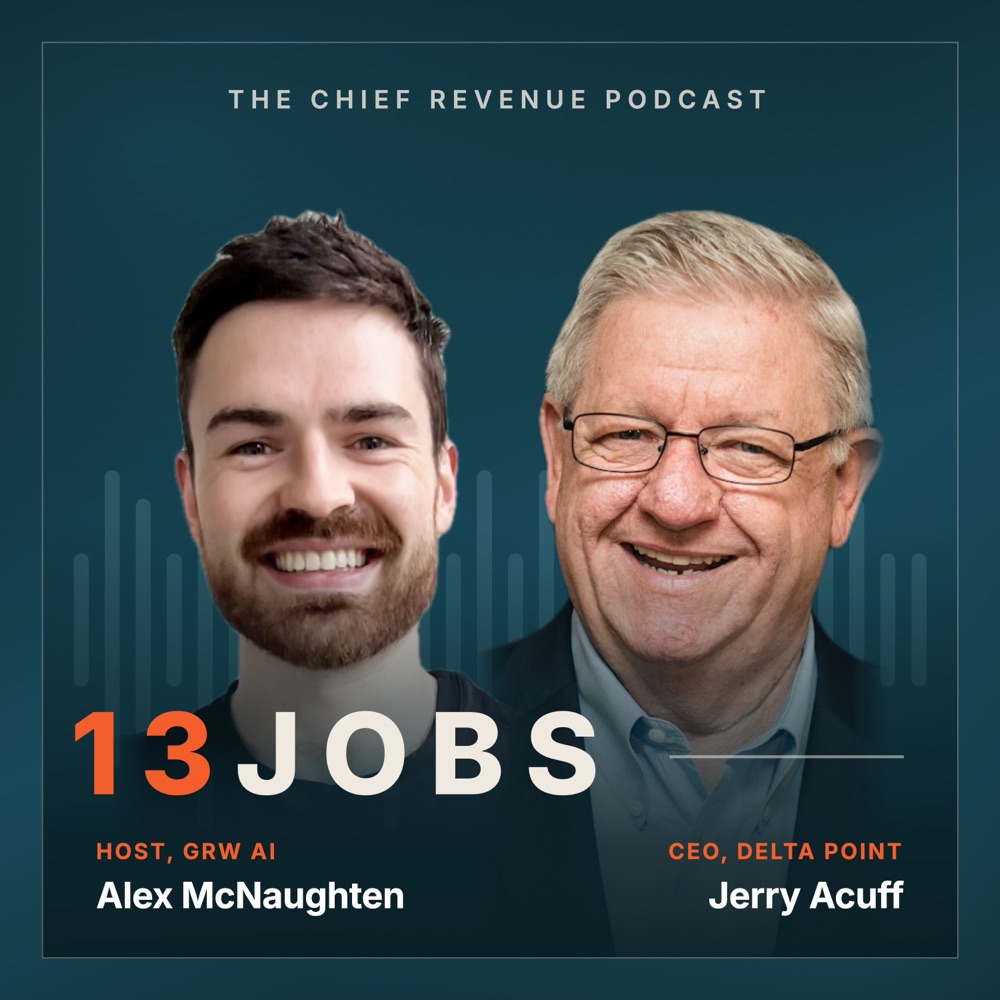
 Hosted by Alex McNaughten
Jerry Acuff · CEO, Delta Point
Jerry Acuff is a renowned sales expert, author, and CEO of Delta Point, Inc. — a consulting firm that has transformed the sales strategies of numerous Fortune 500 companies. With over 30 years of experience in the industry, Jerry is a master at building meaningful business relationships and leveraging them for strategic influence and sales success.
He's the author of the best-selling book The Relationship Edge, which delves into the art of cultivating genuine connections to drive unparalleled sales growth. A sought-after speaker and consultant, Jerry has a wealth of knowledge on effective communication, leadership, and sales excellence.
In this episode, we discuss:
- 1.Selling Lipton tea in Jackson, Tennessee, and getting nowhere
- 2.What Delta Point does, and why he focuses on building the organisation
- 3.The candidate he turned down, and the call that changed his mind
- 4.Everything about the hire that looked wrong
- 5.The week he spent trying to work out how to fire him
- 6.The Friday phone call: what do you want me to do with these orders?
- 7.Let me be my best me, and why a leader does that ten different ways
- 8.What he looks for in a hire, starting with whether he likes them
- 9.The two questions on urgency and competitiveness he always asks
- 10.Why most sellers can't assess where they are in a deal
- 11.Telling candidates the process, and what asking for the next step reveals
- 12.Why he stopped assuming the available candidate is the good one
Quote of the show
“Let me be me. Let me be my best me. And then if you're a leader, you've got to do that 7, 8, 9, 10 times because everybody's going to be different.”
Key takeaways
- Hire for fit with the person, not the profile. The candidate who looked wrong on paper became the best rep in the company within two years.
- Let people be their best selves. A leader has to learn what each person is and isn't comfortable with, then build the culture around that. Ten people means ten versions of it.
- Culture is the first thing, and it comes from hiring. Get culture wrong and nothing else matters. What culture you get depends on the questions you ask before people join.
- Ask for two examples, not an opinion. Urgency and competitiveness are claimed by everyone. People who actually have them produce examples instantly; people who don't, can't.
- The interview is a test of urgency too. Explain the process, then see whether they ask for the next step. Not asking is the answer.
- Most sellers can't place their own deals. Assessing where a deal really stands is rare, and it's a coaching gap rather than a talent gap.
Transcript
Gerry, good to have you on the show. How you doing today?
I'm doing good, Alex. Great to hear from you.
So for those who don't know Gerry, he is the CEO and founder of DeltaPoint and a Wall Street bestselling author. But Gerry, tell us a little bit about your story and how you came to be doing what you're doing.
Well, when my first sales job was right after I got out of college and I was selling Lipton tea, in Jackson, Tennessee. And honestly, Alex, I could not get out of the car to go call on customers. I had such call reluctance. And so a guy called me and asked me if I wanted to coach football, which I went, you know, coach— I went to football, played football in college, and I took the job.
And then I got rejected from graduate school at Northeast Louisiana University, which is hard to do, I think. I mean, I I don't know what they just told me. You know, you got to come and get a real diploma here, buddy. So I said, well, maybe I need to get a sales job.
And my college roommate asked me if I want to get in the pharmaceutical business. And I said, look, I got a degree in English. I was on academic probation every semester except the first and the last. Um, I have no science background and you want me to get a job in the pharmaceutical?
Yeah, but this guy likes athletes. So I interviewed with the guy. And he hired me. And it was— had to be Providence because he was probably one of the greatest leaders I've ever worked for. But he was trained by my regional manager who was the best leader I ever worked for. And then the last guy I worked for is the guy who changed my life.
But all 3 of those were actually trained by the guy in the middle. And so for the first 14 years I was in the business, I had the greatest coaches in the history of the world. And, um, so I woke up one day and I was running a pharmaceutical company, $650 million company with 1,000 employees.
Um, and I did that until we got bought. We were buying another company and I, I was against it. I thought it was a bad buy. And, uh, so they asked me if I wanted to go to Kansas City. And I said, I don't think so. I like Kansas City, but I don't want to go out there because I'd seen the movie.
Um, if they didn't like your, your management, they would go, you know, they'd buy another company. So I decided to be an entrepreneur. And Alex, for the first 3 years, I was not a very good entrepreneur. I didn't— I just really— I hadn't really figured out what I wanted to do. And, um, But anyway, in 2000, well, actually in late '99, I decided that I wanted to do what I was really good at and that is to help other companies figure out how do you sell stuff that's difficult to sell and then how do you actually teach people how to be great sales leaders.
And so I used my network. The guy that I hired in 1986 was now a big shot at a company and he He hired me and then the next thing I know, he gave me a project to work on that was actually, I had to show them how to sell more of this product.
And I increased their business by about $600 million in 12 months. And then I got a reputation that if you got a product that's hard to sell, just call Jerry. And now we've got 16 employees and We've done over 225 of these things where somebody says, okay, here's a product. We're not selling as much as we think we should.
Tell us how to do it. And so we have a whole process and methodology how to do that. When it comes to managers, we've done a lot of training for people who train salespeople. But I think now we're trying to take it to another level and that's what this sales leadership Excellence Development Program is because what we're finding is that an awful lot of first-line managers in any company are not well equipped to teach salespeople how to be great at selling.
And so what I'm gonna do is I'm gonna actually, I've already created probably more than half of it, a program where there's 6 key things that you need to do to be great as a sales leader. And I'm going to teach people over a 6-week period of time by me, only me, what are those 6 things.
And so they'll get everything that I have to give them about the 6 things that I think are really, really important. And then I'll be on every week. I'll be on for an hour and a half to whatever questions they've got. And then they'll also be able to reach out to me and let me tell them You know, I'm one of the top sales leadership experts in the world according to somebody.
Now, when I come home, my wife says, okay, all that stuff's out the window, pal. You just take the trash.
Very good.
Anyway, so that's what we do and we love doing what we do. I have incredible employees that have made my company so much more than I could have done it. Because you can't think of everything. But if you hire really good people, they have ideas that are brilliant. And, and we've got, we got a great team of people and they're all over the country.
I mean, we've got one in LA and we've got one in Florida and we've got, you know, we've got 16 of them. We have offices actually in Malvern, Pennsylvania.
Hmm.
But so that's what we do. I mean, we focus on how do you build A sales organization. I mean, we've done all kinds of coaching models and selling approaches. But what we've found is that those things are not enough. A coach needs to understand what specifically can they do to be great, not good, great.
You know, I was a manager for 8 years out of 60, and I was number 1, 7 out of 8 years.
What led to that?
Yeah, the year I wasn't number 1, I was number 2. Now we have 6 positions.
What led to that, Jerry? You know, like, how did you maintain consistent performance?
Well, a lot of it was— I would start by saying I was smart enough. I wasn't smart enough, Alex, to be totally transparent. I was not smart enough when I started.
Sure.
But the very first person I hired taught me probably the biggest lesson I ever made.
Okay.
And this is a guy who I had turned down for the job. He had no sales experience. He'd only been out of college 3 years and I was trying to hire somebody that I thought worked from IBM, looked like they worked for IBM, you know, at that time. And so I found a woman that I was just enamored with.
I thought she was terrific. She was already in sales, Um, she was on commission, she was doing great stuff, and I decided I was going to hire her. And so then my wife calls me. I was just in Montgomery, Alabama, and I was— we lived in Birmingham. My wife called me, she says, you need to interview this guy.
I said, who is it? She told me, and I said, well, I've already looked at his resume and he's a C. Now a C means I ain't never gonna talk.
Mm-hmm.
And so she said, but he's really nice. And I said, well, a lot of people are nice. He said, no, no, you need to talk to him. So he calls me on the phone and I talked to him and I said, look, man, I— look, you just don't have the— you don't have the background for this, etc.
And his last question in the Alex, he said, well, let me ask you this question. Can't you at least give me an interview?
Hmm.
I thought, well, hell, I probably can. And so, so I hired the guy. I mean, I brought the guy in And, um, he was not what I expected.
Okay.
At all. He was overweight, um, which didn't bother me because so am I. But, uh, he, he sounded like he was a wrestler or something, a real hustler, based on our discussion. But he wasn't that at all. However, I turned him down on a Friday. I decided I wasn't going to hire him, I was going to hire her, but I hadn't told her.
And the very next day, I got 5 letters in my mailbox. Now, this is back before there was, you know, internet.
Sure.
One was from the governor of Alabama. One was from the doctor that would be his biggest customer. One was from his current boss. One was from the drugstore, which he had been managing since he was 12. And the other one was from the president of Auburn University. Now I'm saying to myself, I— my school had 1,200 people.
I couldn't get anybody to write anything about me. But they all said the same thing, you are a functional idiot if you don't hire this guy. He's the most unusual person I've ever met. So I called him that morning. I said, look, I think I made a mistake. I want to talk to you one more time.
But that's not what he taught me. So I hired him. He goes to the training school up in New Jersey. He flunks the final exam. And of course the training department calls me and said, what do you think? And I said, well, what's going on? He said— I said, is he trying? Oh, nobody tries harder.
I said, well, why isn't he— why isn't he passing? She said, well, he's not that smart. And I said, well, can't you get him a 70 or something? Let me test him again. So they did. So he comes back home and I go to work with him. And I always did this, you know, they, they come from training school, I give them a day off and I went to Montgomery, Alabama, and I said, "Look, here's what's going to happen.
I'm going to make calls for a couple of days because you've never seen a call, and then we'll see how this goes." So the very first call I made, Alex, when we finished, here's what his comment was: "I can't do that." And I said, "I said you can't do what?" He said, "I can't do what you did." I said, "Why not?" He said, "That's not my style." And my response was.
You ain't got a style. I'm here to get you styled. So for 3 consecutive days, he would not make a call.
Right.
And after every call, 2 days, I told him, don't, don't give me that. It's not my style. I've already understood that. Right. So instead of staying on Friday, I decided to go home because I said, I got to find a way to fire this guy. And, um, I didn't tell him that. So he asked me when I left, he said, what do you want me to do while you're gone?
I said, well, look, We just launched this product and I mean, my district is leading the country, $5,000, you know, a week, just to see if you can go get the product stocked in some of these hospitals. I'm thinking, okay, I got, you know, I got 8 days to figure out how to fire him.
Right.
And so, um, he calls me the following Friday and I have not figured out how to fire him. And he says, uh, hey, what do you want me to do with these orders? And I said, well, what orders are you talking about? And he said, well, you told me to get these orders.
I said, well, how much is it? He said, $26,000. And I said, I like your style. But, but the lesson that I took from that was really important, and it has colored my— it's colored my whole, uh, career. What he was saying to me is, don't make me you.
Right.
Let me be me. Let me be my best me. And then if you're a leader, you've got to do that 7, 8, 9, 10 times because everybody's going to be different. And so what he taught me was that I have to learn what people are comfortable with and what they're not comfortable with.
And then how can I create a culture? Because number one in my list is culture. If you don't get culture right, doesn't matter. Now, culture a lot of times depends on the people that you hire and what are the questions that you ask that bring you the kind of person. I mean, I want a person who has, um, very good people skills.
I want somebody who has a serious sense of urgency. I want someone who has a really hard, big-time competitive, uh, spirit, um, and, and somebody who's dying to be successful.
Yeah.
Um, and so, but he taught me that in that one, in that one week I said to myself, my gosh, now everybody else I got to hire, I've got to hire people that are like him. And, um, you know, he's— to this day, he's— talked to him yesterday, um, you know, and he replaced me when I left to go to the home office.
But, but I learned an awful lot because what I learned is I had a lot of really, really good people and And I had a problem because at any given point in time, if I had 8 people, all 8 of them were in the top 50 of the company and there were 600 people.
And so, but I got the same amount of compensation for those 8 people as somebody got who had 2 or 3 performers. But if you create the right culture, people will be proud of that because they know that they're on the best team that there is in the country. And so to me, the first thing you gotta do is you gotta get culture right.
Now, you can't get culture right if you don't know what you're looking for in terms of what kind of employees do you want and what kind of people do you want. Because when I only fired one person in 20 years, well, that, and he was the first person I hired. Well, I've hired, I fired him after 3 weeks.
What? So there's a lot there and I'd like to unpack a bit of it. Maybe starting on the what do you look for side when you're hiring people? Yeah. How do you figure that out? You're a new leader, you've just come into the role. How do you figure out what you should be hiring for?
Well, I don't think it's very complex. I mean, I think that there's several things to me that say that this person will be wildly successful. Number one, do I like them?
Okay.
I mean, do I Do I connect with them as a person? Secondly, and if they connect with me as a person, I'm going to make the assumption that they can connect with anybody because I'll ask them questions to see what kind of stuff that they'll tell me. And I'll be looking for them to be honest about what they can and what they can't do.
The second thing is I want someone who can prove to me, and I'll give— I'll create a question that gets them to show me that they have a sense of urgency.
Uh-huh.
I say, give me 2 examples of when you have had to use your sense of urgency to make something meaningful happen. And if they can't tell you, they ain't got a sense of urgency. The third thing is I want to know how competitive they are, but I got to ask questions that say, give me 2 or 3 examples of just how competitive you are.
And if you can't think, I mean, I can tell you anybody that's really competitive, they can tell you that in a blink. Because they know exactly what it means to be competitive. Um, and, uh, and I've already decided that I like them, and then I want to find out that they have that sense of urgency.
I mean, if you don't, if you don't have a sense of urgency in sales— now that doesn't mean that you got to slam stuff down people's throats.
Sure.
But what it means is that when you get, you know, when you, when you get an opportunity You're going to do what you can. I mean, my people, I had to, I'll give you an example. One of my, one of my reps, and I, he was my 3rd or 4th one I hired.
He calls me one day and he says, this physician was using a competitive product and he was using a lot of it. And so he calls me and he says, how often do I call on this guy? You know what my answer was? You call on nobody until he's writing our product. You tell me where you have a better opportunity.
It makes no sense for you to call on anybody else. So if I were you, cut his grass. I don't give a damn what you do. I mean, I want you to do whatever you do is legal. Uh, I mean, but I said what I want you to do is to find the reasons for you to go back there so you can continue to have conversations with Now that might take you 2 days, 3 days, 4 days.
But if you're asking, is that more important than calling on somebody that you don't know whether they can actually use your product to the degree that this person has? You gotta go get the business where the business is. Now, it took him 2 days to get the business.
Hmm. Hmm. So, okay.
A lot of it is, you know, can they assess where they are in terms of a sale? I mean, I can tell you that the vast majority of people in sales period are not excellent, number one. And when I think, you know, when you say 75% of people fail to hit their target.
Close to that. I think the data I've seen recently is 39% of people are hitting their quota in 2024. Yeah.
Well, It's not good. That was not my experience when I was a manager, and it wasn't my experience when I was running the company either because I think we created the right culture. But you got to have the right questions when you're interviewing people. So now I always interviewed people at least twice.
So the first one was 30, 45 minutes to see if I liked you, but everybody got 35, I mean, 45 minutes. If I hated you the first minute you walked in, I was still going to leave you with your dignity because I think that's really important. And at the end of that, I would make a decision.
Do I want to see this person again? Now, let me tell you this.
I had—.
When somebody came in, I would say, let me explain to you my selection process. We're going to have this interview. It's going to be 45 minutes. And if I like some You know, if I like what you hear, I'm going to bring you back here for probably a 2-hour interview, and then there'll be a ride in the car with one of our people, etc.
So those are the sort of the ways that you go. If you didn't ask me for the second phase, I would never talk to you again. Because what I learned is that if you have a sense of urgency, yeah, and you're really competitive, You're gonna find out, well, when can we have the next interview?
Exactly.
Now, if I don't tell 'em that and they don't ask the question, what's the next step? I don't wanna see 'em either. So, um, I think the key is to say, what are the traits that I'm looking for? And those traits, Alex, can exist in people with dramatically different, um, personalities.
Yes.
Yeah, and I could care less. What I did learn was that when I had somebody like the first guy— now, by the way, the first guy that I talked about, within 2 years— now understand, in, in, in 3 weeks I was going to fire him. In 2 years, he was the number one rep in the country out of 600.
So, and the second guy I hired My boss told me I had to fire him. And I said, why? And he said, because he's not that smart. And I said, what do you mean not that smart? He said, well, he can't say Pseudomonas aeruginosa. I said, Gene, let me tell you something. And this is the thing I loved about my boss, because he would listen to you.
And I said, look, I can teach this guy how to say Pseudomonas aeruginosa. I can't teach him to work 100 hours a week. And he works 100 hours a week. Now you tell me you want me to get rid of this guy? 2 years later, he's number one. And he was a buyer from JCPenney's, no sales experience.
The other guy was working in a drugstore and a junior college. I hired one person in 20 of the 20 people I hired who had pharmaceutical experience.
Hmm.
I didn't believe in them. Usually, usually my experience was that you're getting somebody who is not that good. Why would they be looking?
Interesting. So you, it sounds like you really hired for a few key traits and attitudes.
Yes. Well, I mean, obviously, you know, you can tell if you talk to somebody for 45 minutes whether they're smart or not. You can tell in 45 minutes where they're social enough and where they're likable enough. And once I could check that box, then I said, okay, now I got to figure out You know, do they, do they have a sense of urgency?
Are they really good at speaking to other people? Do they have a, uh, are they really, really competitive? And how can they prove to me that they're competitive? Now, the other thing that I did back then, and you can't do that now, um, but I, but I also checked all of their, um, references.
Sure.
Now, there's the one person that I did not check their references, and I'll tell you that story, uh, is probably the most successful person I ever hired. And, uh, so when I interviewed him, and, and he'd only had 2 jobs, and I told him at the end, I said, look, I really like you, but I'm not gonna hire you.
Right.
He said, what? I said, because I can't check your, uh, I can't check your references. He worked for Kraft Foods.
Okay.
And I said, he said, well, why not? I said, because you're not gonna let me talk to your boss. I said, you've only had 2 jobs. You had one job working for your dad's best friend. I discount everything he said. And I say, and, and the other guy, this is your current boss.
You're not gonna let me call him. And then this is what he said to me. He said, so let me answer your question. He said, if I tell you that you can call my boss right now, And if he says to you that I'm as great as I think I am, you'll hire me.
And I said, yeah, but you're not gonna let me do that. He said, yes, I am. Give me your phone. And I looked at him and I said, put it down. I'm hiring you. And he is pretty awesome. He wound up as the president of a large pharmaceutical company in China, and now he's global head of a huge brand here in the United States.
So he's the most successful person I ever hired, but I didn't check his references.
I wanna bring it back to—.
I knew if he had that kind of guts, yeah, had to be, the guy had to be saying the right thing. So.
I wanna bring it back to something you were talking about earlier, which is, you know, you can't expect people to be you. Like you don't want them to be you. So my question is, how do you as a leader get the best out of your people? Like, how do you help them to be the best version of themselves?
Well, this is— there's several answers to that. Number one is you have to create the right culture.
Okay.
And your culture has to be one where what matters is the team and not the individual.
Okay.
Because if you have a, High-performing team, you're going to have issues, organizational issues, because you're probably not going to be rewarded the way you should be rewarded because you got too many high producers. And I had that every year I was there, but my people didn't care. The other thing I did is I decided that if we're going to be the team I want us to be, we need to have the right name.
And this is a lost art. Uh, so I named them the Generals. And so, and, and I will tell you, I have not, I have not worked for these people, with these people since 1989. They want to have a reunion of the Generals.
Hmm.
Because of the, the, the, uh, camaraderie that we built. Nobody got jealous of somebody being the number one person in the country and they were number 5. They didn't. What they wanted to do was, how can I learn from these other incredibly successful people? So we fought. So we also fostered an opportunity, and this is especially true with your better and more experienced reps.
You give them an awful lot of authority to go out and work with people and teach them what to do.
Yeah.
It doesn't always have to be me. It could be, I mean, look, I got salespeople that were better than I was, but But the competitive ones, I mean, I had one guy, our company, our country, I mean, the biggest product we had, our share was 10 points.
Okay.
My share was, I had the only share in the country over 20 and mine was 33. I had one rep who had 75, 72. And I tried, we were riding down the road one day and I said, hey, Danny, we'd seen like $10. And I said, let's go bowling. Bowling? I said, yeah, let's go bowling.
He said, we gotta get more calls to make. I said, Dan, we're gonna have some fun today, okay? You understand? We're gonna have fun. We're gonna go bowling. You sure? I said, yes, I'm sure. I want us to go bowling. And so you have to introduce fun in your group.
Okay.
You have to have— you have to let them understand that you're You're not a king. You're just their supervisor. And you'll do anything in the world to help them succeed. And if that means giving them somebody else to work with them to get them shined up on something that they could get better at, they all wanted that.
So you have to create the right environment. And that's to me the whole process of the culture. Now, it also means that you have to figure out When you're planning for your organization is, what am I looking for? And I told you what those things are because if I actually understand what I'm looking for and I can find it, I can be wildly successful.
But I hired a woman who hadn't worked in 10 years. She was a home housewife. But when I looked at what she was doing, As that mother of, of, of 2 kids, I mean, I don't see how she, she got anything done. She was going, she was doing something all the time. And I'm saying, I want somebody that's a doer.
I want a doer, someone who can prove to me that their history is, is doer. Uh, I heard an LPN, not a registered nurse, I had an LPN, wildly successful. So you have to find out what, what people treasure. That's a really important thing. But I think a lot of this is you got to have fun.
If you don't have fun, then, you know, you're just an ogre. And, uh, now that doesn't mean you can't hold people accountable, because you better hold them accountable. But they need to understand when they get into your group, you are going to make them accountable.
Mm-hmm.
You're going to tell them there's greatness in you. My expectation is that I'm going to experience that greatness with you. And anything that I can do with you or the team, I'll do that. Now, the other thing that's interesting is of the 19 people I hired— I hired 20, but the one guy I fired after 3 weeks, uh, the other people of those 19, 13 got promoted.
13. And now nobody had a record like that. And so when you go into work a place, when you go into work, in a place where you can advance. Nobody's going to hold you back because you're already good. These people are going— I'm going to help you be whatever you have the potential to be.
You got to have that kind of environment. And I think the other thing is you have to make sure that you have leaders. They're like the first person I hired, one of the best leaders in the history of the world. So he could, he could basically do my job. After 2 years. And so if I had to, if I needed somebody to, for him to teach, I could send him.
I could send the other guy who was the number one rep in the country after 2 years. And they wanted to do that because they are hungry to help others. So you have to find people that are not selfish, people that are confident, and people who want to help other people succeed because they know that nobody succeeds alone.
I feel, Gerry, that we've barely scratched the surface. I've learned a lot in this conversation. I feel like we've barely scratched the surface, but I'm conscious of the time. So I want to ask you one last question before we wrap.
Yeah.
And then I want you to tell people where they can find you and go much deeper in this conversation on this topic than we have today. But I ask everyone who comes on the show this question. What if you were to go back to your first day on the job in sales, day one?
What is one piece of advice you'd give your younger self?
The less you care about the sale, the more you sell. I mean, I would have learned that far, far earlier than I did before because the re— and I write that in one of my books, but what you care about is the customer and trying to find out whether there is a fit between your product, your service, and what the customer's looking for.
And I would say that the vast majority of people do not get that level of understanding because they're too interested in trying to sell their product. I think the only other thing I would say is, um, relationships really matter, especially with the gatekeepers. And if we don't treat the gatekeepers like as good or better than the person that you're trying to speak to, you have no right to try and ask them to help you get successful.
So, um, I think, you know, a lot of it is just learning that there's a lot to learn. But, uh, but I do think that if your mindset is, I don't care whether I sell or not, what I care about is am I doing right by this customer?
Mm-hmm.
Because if they need me, I want to, I want to try and give them reasons why they ought to think about our product. And if we can't, then we should stop calling them. We're wasting their time and I don't wanna do that.
Great advice. Gerry, where can people find you if they wanna connect with you, if they wanna learn more about what you do, go deep on some of the topics you touched on today?
Yeah, it's, well, my email is gerryacuff@gmail.com. At deltapoint.com. But if you want to know more about what we're doing with SLED, it's jerryatecuff.com/sled, SLED, which stands for Sales Leadership Excellence Development. But I mean, my telephone number's on the web. So, and I, if, you know, if people call and say, when are you free?
I usually say, I'll tell you when I'm free, and if you want to call, you know, I'll be happy to talk to people. Nobody succeeds alone. I mean, that's just one of the most important things that I ever, ever learned. Uh, but also learned one other thing, and I learned this when my father was dying.
I was— I went to see him when he was dying in the nursing home, and I'm named after him, and my brothers and sisters call me FHB, which means Fair-Haired Boy. Um, and so, and this is in 2010, and this is where I really learned my purpose. And so I went to see him, and my brother told me on the way up there, he said, he's, you know, he has no cognition, you know, he's got Alzheimer's.
And so, okay, so we were there for maybe 90 minutes, and when I got ready to leave, I had looked at his chart, and he was taking a product from, uh, Novartis called Exelon Patch, which was for cognition. Now, my brother told me he had no And he hadn't had cognition in 6 weeks— 6 months.
So when I got ready to leave, I bent down and kissed him. And when I got to the door, he sat up in the bed and he said, Jerry. And I looked at him and he said, I love you, son. And I'll never forget walking out of that nursing home. I'm saying to myself, I just had a life-changing moment.
Because somebody in sales did their job. And I've, and I've never forgot that our job is to do exactly what that person did— change people's lives by doing the right thing. Because I didn't think that he had any cognition, and I never saw him again. Next time I saw him, he was dead.
Uh, but I had— now what was good for me, I had spoken to that company, you know, about a month after that. And the person, the manager, called me and said, hey, I know the guy who actually called on that doctor. And then I got to talk, I got to talk to him.
And I told him, I said— he said, you know, I can't believe you're calling me. I said, why? He said, because you're like a celebrity. I said, look, man, I'm just another person. I said, but the difference between you and me is that you changed my life. I didn't change yours.
Hmm.
And so I'll never forget that. We need to Focus on how can we be as good as we can be because what we do matters.
100% agree with that. Jerry, thank you for coming on the show and sharing your wisdom and stories.
Thanks.
It's great to meet you. Yeah, likewise.
I appreciate it. Thank you much.