
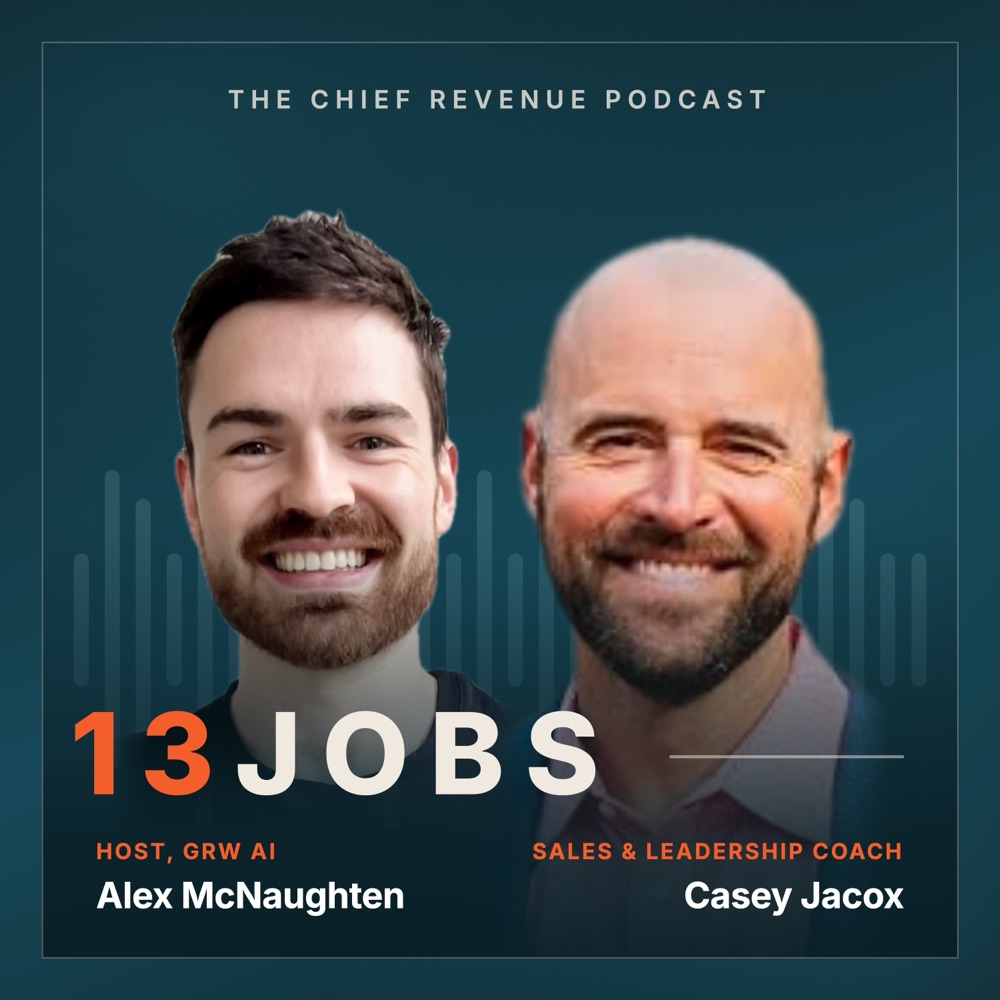
Coaching and how to be coachable
Everyone wants to coach and few want to be coached. Casey on hanging your ego at the door, and reaching the person who thinks they're above it.
 Hosted by Alex McNaughten
Casey Jacox · Sales & Leadership Coach
Casey Jacox is a nationally respected sales and leadership coach who helps individuals and companies unlock the power of humility, vulnerability, and curiosity to build stronger relationships and drive sustainable growth. With over 25 years of business experience — including an extraordinary run as the #1 sales producer at a publicly traded company for ten consecutive years — Casey now coaches sales teams and leaders on how to lead with authenticity and exceed revenue goals without ego.
He's the author of the acclaimed book "Win The Relationship, Not The Deal", a practical guide for sales and business professionals focused on long-term success. Casey is also the host of The QB Dad Cast, a podcast that blends leadership and fatherhood, helping men show up better at home and in life. A former college quarterback at Central Washington University, Casey brings his competitive drive, humour and humility to his work.
In this episode, we discuss:
- 1.From college quarterback to 25 years in sales and leadership
- 2.If you have to tell me how good you are, you're not that good
- 3.What being coachable actually means day to day
- 4.The top producer who was eroding the culture, and how he got in
- 5.Asking about the career instead of the numbers
- 6.Knowing when to shut it down: coaching has to be their choice
- 7.Tell me why: the question he asks someone who refuses coaching
- 8.Why leaders have struggled with accountability since COVID
- 9.Showing people you listened by turning it into action items
- 10.Expectations, at work and at home, and setting yourself up to fail
- 11.The mentors who shaped him, starting in high school
Quote of the show
“It means your ego is always at the door. You're going to hang your ego on the hat rack, and you go into any room and you're going to realize there's someone a lot smarter than you there. And if you're the smartest in that room, I'd probably say that's probably not the right room for you.”
Key takeaways
- Hang your ego at the door. Walk into every room assuming someone there is smarter. If you're the smartest one in it, you're in the wrong room.
- Coaching only works if they choose it. You can require the meeting, not the willingness. Casey will shut a coaching relationship down rather than push someone who hasn't opted in.
- Ask why before you sell the value. Faced with a refusal, he asks them to describe what would happen if they learned one thing that made them money. Curiosity opens more doors than authority.
- Numbers don't get you in with a top producer. Out-performing someone doesn't earn their attention; it inflates their defences. He found the way in through what the man cared about outside work.
- Proof that you listened is action, not agreement. Turning what you heard into written action items is what makes the next conversation possible.
- Unspoken expectations set you up to fail. At work and at home. Saying what you expect out loud is what lets someone correct it before it becomes resentment.
Transcript
One. Casey, good to have you on the show.
Yeah, I'm grateful to be here. It's gonna— I meet with some friends in common. It's gonna be fun to have a good, a good chat today, Alex.
That's right. And for those who don't know Casey, you're a sales and leadership performance coach, speaker, an author, and of course a dad. But yeah, tell us a little bit about yourself. Tell the audience who you are and how you came to be doing what you're doing.
Yeah, I'm a former college athlete. So I played the, played the grapple position of quarterback, which I always, whenever I talk about my old football days, I gotta give love to Uncle Rico from the movie Napoleon Dynamite. To make fun of myself. But game of football taught me so much about grit, resilience, humility, vulnerability, curiosity, things that most salespeople, at least the elite ones, possess.
I am a dad, most importantly. I got a college freshman who plays golf in school. I got a daughter who's a junior in high school. She's a high school basketball player. Been married to my wife for 26 years.
Congrats.
And spent— thank you— spent over 25 years in sales and sales leadership. Um, in March of 2019, I, I left to kind of like the perfect divorces. We kind of came to a point where it was kind of the time to say goodbye and left on great terms. And I used that time where I was on the sidelines to write a book, um, called Win the Relationship, Not the Deal.
Started this podcast for dads called the Quarterback Dadcast. And then coaching and speaking found me, Alex. I did not mean to do this, but it is so fun. So now I'm, I'm working with sales teams or sales leaders in coaching or executive coaching, or— and I also play like a fractional sales leadership role for a few companies over here in the United States.
But it is an absolute calling because it's— I mean, you can go to coaching school per se, but like the advice I give is through a lot of street fights, a lot of experience. And I think the best coaches I've worked with, they ask great questions and then they help people kind of coach themselves versus someone else telling you what to do.
So, That's really what I'm up to now and I'm having some of the most fun I've ever had in my corporate career, my, actually my professional career.
That's awesome. Sounds like it's been quite the journey. And I noticed in that kind of little like opener there, you used the word coaching a lot. Like you used that word coaching, I think more than 5 times just in the last few minutes. And so I'm getting the impression, it seems like it's an important thing for you throughout your career and probably even going back when you're an athlete as well?
Being coachable is super important. Um, you know, I think there's always another level. Like, once you think you've, you've done really, really well, there's like 10 or 15 men or women above you. Um, my college football coach in college told me, Casey, if you ever have to tell me how good you are, you're not that good.
But when you're great, I'll tell you. Um, so that always kept me grounded. Um, I had great coaches in high school. That taught me so much about visualization and goal setting and self-talk, which are important in sales. Even now, when I, in my entrepreneurial journey, I've hired 3 coaches to help me with certain things.
And so, I like trying to, any room I go, I like trying to humble the room with my own humility and my own vulnerability of things, saying things that I suck at or I don't know, because the one thing we all have in common is that we're all flawed humans. I know that for a fact.
Yep.
And then we all can get a little bit better tomorrow if we have the right mindset, which again, that's something that I, I work on hard, uh, myself, but also with people, my clients I work with. Because people don't— I don't think enough people in corporate America or corporate world focus on their mindset.
Uh, they, they'll exercise, they'll work on their body, but they don't work on their mind. And the mind is a powerful, powerful tool, um, that when you focus on it and you, and you really take time to think about the words you say to yourself and the preparation you do, um, how you treat people.
I mean, it's, it's the little things, but they make a huge difference in set of cultures. I know that, and the relationships you form.
What does that mean to be coachable? Like, what does that actually look like? We— I've spent a lot of time on this podcast talking about like, how do we coach and what does coaching look like? But like, I don't think we've— anyone's ever brought that up before, which is like, What does it actually mean to be a good receiver?
It means your ego is always at the door, right? You're going to hang your ego on the hat rack, right? And you go into any room and you're going to realize there's someone a lot smarter than you there. And if you're the smartest in that room, I'd probably say that's probably not the right room for you then.
I think coachability is just— it's, to me, it's— I love learning, Alex. I love I love hearing about— because I'm super curious, so I love learning about people's stories and journeys. And, um, but coachable is just like realizing that your way might be your way, but there might be a better way, and be open-minded to figuring out what that better way looks like.
Because if you can help make you and your team more efficient or more effective, why wouldn't you do it? You know, so like one of my favorite— yeah, well, one of my favorite pieces of advice I got when I was 22 years old My sales leader said, Casey, he asked me a question and I actually used this question when I was hiring sales teams.
He said, do you want to be right or do you want to get what you want?
I said, good question.
I want both. I want both. He goes, you can't, you gotta pick one. I'm like, shoot. Okay. I want to get what I want. He's like, good answer. I go, why? He goes, well, why do you think? He didn't give me an answer. I go, well, because I guess if I'm being right, it's about my ego.
He's like, good job. It doesn't matter what people focus so much on being right. And like that mindset of being coachable, obviously, I think helped me in my sales career. Because, and then if I'm always trying to convince the buyer that I'm right or he or she's wrong, they're going to resist me.
But if I ask great questions and be open-minded to a different outcome, well, maybe they're going to sell themselves more than I'm going to sell them. So I don't know. To me, I think coachability is— it's also infectious to be around. You know, no one likes working with, pardon my French, assholes that are—.
That always whine about everything.
Right. So, yeah, I hope that answers your question.
No, it does. And because I think one of the challenges, like, oh, I've experienced this one personally. I've probably been less coachable at times in my career, especially earlier on as well, like thinking I knew a lot more than I did. And How do you get in? How do you get through to someone who's not coachable?
Because, you know, in any given team, you might have 25% of the team who are like super coachable, super hungry, like always looking to learn. Then you got it like probably 50% in the middle who are maybe like open to it. And then you got the 25% at the end who are just set in their ways and don't wanna make change.
How do you get in touch with, like, how do you reach them? How do you reach that bottom 25%?
Well, I can't guarantee I'll do it every time, but I can tell you how I've done it thus far.
Cool.
How about that?
Yeah.
So how, how I've got to people that are like leaders who have brought me in, like one of my favorite stories I love telling is, um, uh, there was a, a number one producer at a company.
Mm-hmm.
That was not coachable, that was a huge a-hole that was eroding their culture. Yep. And they— I was, I was the number one producer for 10 straight years at the company I was, I was at. And I, and I had probably 4x of this guy's business in the staffing industry, right? Um, but I didn't— but it doesn't matter if I tell him that.
He's going to be— he's going to— his ego's going to get bigger. So what I heard about him is that he had— he loved his family. And I learned that he had, um, his dad was, uh, going through some stuff. Well, my dad passed away on December 29th, 2021, of, um, a bunch of stuff.
A lot of it was Alzheimer's and dementia at the end. And So I use curiosity to connect with him first, and I, and I use curiosity to see. I just want to get to know him. I didn't tell him what I did. I didn't tell him. I just said, hey, your CEO wanted us to meet.
And hey, before I— he shared with me you got some of your stuff going on with your dad. I just want to say I'm sorry. My, my dad's really, really sick. So I know what it feels like to go through that. So I found connection to develop rapport, which goes to trust. So I think when we as we're trying to train people who are fixed mindset, if we try to tell 'em what to do, they're gonna resist us even more and more and more.
But I think when you're curious, genuinely curious, and show up authentically trying to connect with somebody, that's how you get to them. So back to the story, I, I, I, he's, he, I just kind of threw out a, like a small little snack and he, and so that he wanted to get curious and he asked me more about my dad.
And I said, well, you know, unfortunately my dad passed away and it was, you know, it was really, really tough. So if you're going down that same path, you know, I'm more than happy to help because I think your, your co— your CEO wanted us to talk about potentially like sales and leadership coaching, and I don't even know if I'm the right guy for you.
I mean, I, I, I wanna make this your idea. And so if you feel like based on what you learned from me, if I can help you, great. If not, he's like, oh, okay. Well, and I just, I just didn't say anything about me. I just slow played it. And then he started asking me a few more questions about my dad, about life.
And, and then he goes, well, did you ever spend time in the staffing industry? I go, a couple years.
Yeah.
Well, how many? I don't know, a few. Well, how many?
About 20.
Oh, wow. That was a long time. I go, why is it not that? I mean, you, you got a, you got a huge career here, dude. I've been more impressed with what you're doing. Put it back on him, trying to pump his ego. He's like, well, like, dude, were you pretty good? I go, I mean, you have to ask other people.
I'm not going to tell you how good I am. He goes, well, like, I'm the number one guy here. I go, that's awesome, man. Good job. He goes, where were you? I goes, I was number one too. Oh, you were? Well, how many years? Well, how many years are you? Well, 3. I go, I was 10.
He's like, his eyes are getting bigger, his mouth. And I go, listen, if the people I want to work with are the people that can start a coaching journey saying, hmm, yeah, I've had a lot of success, but maybe there's more out there that I haven't learned. And so if you're interested in going down that path, I'd love to help you because what I hear about you is, you know, you have this much.
I did this much for 10 straight years, which is 7 more years than you've done it. And I'd love to show you how I did it. And things that worked. But if you're not interested, that's totally fine. I don't want to have to force you to do it. This— and this has to be your idea.
But so let me know what you want to do. Well, then he ends up freaking telling the CEO. CEO— they end up hiring me. About a year later, the CEO calls. He goes, dude, I don't know what you freaking did, but the guy's like been brainwashed. He's a totally different guy. So like, that to me is like the most rewarding thing, you know?
Right.
But I mean, full circle, I'd say there's some people that are never going to be coachable.
Right.
And if I, if I'm working with somebody out of the gate, I might shut it down just to say, you know what, this is not for you. Try to do like the takeaway, just like in that works in like sales process when your pipeline stalls, like take the deal away. Like that's— don't spend time on stuff that's not going to be a good use of your time.
And I don't want to spend time coaching somebody that's not coachable. But I, before I get to that point, I'm going to ask a lot of questions to try to see how I can maybe drive a connection or build some rapport with he or she.
Yep. You said something interesting, which is like it has to be their choice. And, you know, I think that's, that's hard because as a manager of a team, you wanna, you wanna be helping your team, you wanna be leveling them up, you want them to be doing the best they can possibly be, do.
But, you know, when you have those folks who just don't want to receive it, they don't wanna opt in. It's quite difficult. What do you do with those people? Like, what do you do if you, like, let's play that scenario back, right? The one you just ran through. What if that scenario was like, the guy was just like, I don't wanna be coached.
I'm doing it my way or the highway. Like, what do you then do with that person if they're a negative kind of cultured drain on the team?
Yeah. Well, so there's a curiosity framework I got taught that's called TED. Stands for tell me, explain, describe.
Okay.
So if someone says that to me, I'd say, well, tell me why. And that's it. I'm gonna say, tell me why you feel like you don't want to get coached. Describe what would happen if you actually learned something that could make you earn more money. Describe what would happen if you learned one more thing that might get you to have a customer refer you to 2 other customers you didn't know about yet.
Tell me how that'd make you feel. I might, I might get more curious, but I also might just remind them like, hey, well, listen, this, our culture is a culture of growth and growth mindsets. And so we'd love to have you. You've done a really great job, but if you don't want to be coachable, this might not be the right place for you.
And that's okay.
Right.
I mean, I think sometimes being transparent with people and which most leaders I've found coming out of COVID they really struggle with accountability. And they've let, they've let people on their teams last way too long.
Tell me a little bit about that. What have you noticed? That's interesting.
I've noticed that I think because everybody, some people are still remote that they don't really know what's going on behind the scenes, right? Maybe they're, they've, they've allowed cameras to be off when they're coaching them. They, or they're like handling a meeting. Maybe they're as a sales leader, maybe they're talking the whole time, which I, I help leaders with that because leaders who talk the most increase fear inside their organizations, I found, which increases employee churn, which confidence goes down, uh, lack of practice goes down, which means we're practicing on our clients.
So I've, I've just found that if, if you're not clear with accountability, Which means we set really good expectations and then we have an agreement of those expectations. Not like a formal contract, but it's like, okay, just wanna make sure we're on the same page. This is what I'm expecting of you. This is what you're gonna expect of me.
Tell me, are we on the same page? Yep, we're good. Okay, cool. Now, one thing that I got taught late in my career is sending a, a meeting recap.
Mm-hmm.
I actually give a real example in, in the, in the book I wrote, but In that it shows the person that you listen to them, you have action items outta next steps, and we have now like a kind of a flight plan to fly this plane together.
Hmm.
That really was mainly done for external, but I started using it internal and I'm still in corporate now. I have clients that use it and they're like, oh my God, this has saved me so much time because it's, it's taking that unsaid, I, I set expectations. Well, did you?
Hmm.
Because I know about like an, in a dad, as an early young dad, I don't know if this speaks to some of your listeners, but like I would have expectations of how when my son was like 1 or 2 years old, like how the day is going to go. Okay, he's going to wake up this time.
We're going to take naps. He's going to do this. Then we're going to go to this house. It's going to be great. And in my mind, I like set these expectations that were so far false and they were never going to happen. But in my young dad life, I was trying to tell myself this is going to happen.
Yeah.
Well, I would set myself up to fail versus, you know, hey, honey, I think this is what's going to happen. She's like, Case, that's not going to happen. This is going to be a shit show today. Trust me. We got kids, they're freaking young. And so I'm like, same thing in business is like, if you don't set clear expectations with an agreement out loud instead of leaving them in your head, you— I think you expose yourself for so much unnecessary risk and frustration.
Where did you learn a lot of this from? Like, who taught you?
I've had many mentors along the way. I mean, that's a long list. I can think of— it starts back in high school, starts back to me. My wife's been a great mentor, my parents. One of my, one of the biggest sales mentors that I still look up to today is a guy named John Kaplan.
He's a CEO of a company called Force Management in the Americas, and he's a beast. He is. I just, he gave me one of the, like, I thought it was kind of like a, I thought he was making fun of me and probably he probably was, but he told me it was a compliment.
I still don't know if I believe him sarcastically, but he called me one of the most unconsciously Competent people he's ever trained. I go, that doesn't sound good. He laughed. He's like, no, it's good. It's just, it's, you're doing things, just you're doing them and I'm going to slow you down so you can teach what you do.
Yeah. Okay. Okay. So he's a, he's a big one. There's other guys like Jeffrey Neal, Kai Mitchell. Those are great leaders of mine back in the day. But a lot of it's just experience, I think. And I think a lot of the stuff we've talked about today, Alex, it's, it's so easy for leaders to, to wanna tell everybody everything or salespeople to tell their client everything.
But I think when you use, I say 3 superpowers that most people don't spend time with, and you and I talked about it before we started recording, which is one of 'em's curiosity.
Mm-hmm.
The other one's humility and the other one's vulnerability. Most sales teams I work with are like, what are you talking about? We're, you know, we're talking about AI and sales funnels and this and that. I'm like, cool. But that's common and uncommon. Sales teams talk about humility, vulnerability, and curiosity because I think they're superpowers in how we build relationships.
Mm-hmm.
And so I think when, when those things are present, the leader doesn't have to be the smartest in the room. The seller doesn't have to be the smartest in the room. Just like a, a sales leader wants the rep to coach themselves and, and, and, and be the hero of their own journey, just like I want my client to be the hero of their own journey.
It's our job to kind of help them get there. It's just like it's a leader's job to help the rep get there.
What made you want to write a book?
Have you ever seen the movie Christmas Vacation?
No.
When you get to America, you got to watch it. It's a— it's one of the best holiday movies.
Okay.
So I wanted to write a book. I had a— I had a goal like back in 2010, and then when I was in 2013, '14, I knew I wanted to write, but I didn't want to write it when I was still at my corporate job because it would have been too easy to make an excuse for not being able to get done.
Hmm.
But, um, so I was— I knew it was out there. I just— it was like this, an in— in some, you know, inner voice or a drive just said I wanted to do it. And, uh, the, uh, the reason I bring up the movie, that's how the, the title I think of it.
So I was, I was traveling to Dallas, Texas quite a bit at the end of my corporate career and training some younger sales folks, and I was encouraging them to— I said, it's my expectation that you're going to win every deal. Well, you're not, but go into them with mindset to compete like you're going to win.
But the most important thing for you to do is win people. So how can you win customer or win a relationship when you lose a deal? They look to me like blank stare. I go, imagine staffing industry. So imagine you're— I'm competing against you and I lose to you. And I'd go to, you know, ABC executive.
I'm like, hey, I, and I follow up after you beat me. And I'd say, hey, Mr., Mrs., client, you know, thanks for the opportunity to compete. I'm bummed we weren't the ones to figure it out to get you the right talent, but I just wanna make sure that Alex and his team over at, you know, Sammy Staffing, you know, did everything they, they were supposed to do and that you had a great experience.
I just wanna follow up to make sure. Now, when I did that, a couple things would happen. Either I would follow up before you when you won the business. Or I would follow up and your person would not be that good. And they'd, and they'd say, Casey, actually, his— that company's person didn't really do well.
Is your person still available? So I'd pick up low-hanging fruit. Or they'd just say, hey, Casey, thanks for following up. Yep, you bet. We'll give you a chance to compete in the future. And so when I said this, I said, it's more important to win relationships than transactional deals, because when we win relationships, deals will always follow.
And right, right when I said that, Alex, I was like, That's it. That's the title of the book. And the biggest reason I'd say, actually, back to answer your question, I wanted to write a book that helps solve the problem of companies stop telling their reps how to— you got to build relationships, you got to go build relationships.
Well, no, I didn't find too many people slowing down to actually teach them how to do it. And that was really the goal is like, here's a, here's a 6-step framework, things that we all have control over. That if you do these things, most likely, more often than not, you're going to make friends and people are going to want to be around you.
And it was about being nice, bring energy to the room, always set expectations, be a great listener, document in the CRM every single day and make it your Bible where you put everything. Uh, chapter 5 is about ego. Keep your ego checked, be vulnerable to learn and practice your craft. Practice asking great questions, practice handling objections.
Objections. And then lastly, let— be patient. Let your rela— let these relationships form. Don't force it. And when you ask the right questions, it'll unlock the right door to make the right relationship happen. So that's why I did it. It's, it's been everything I've ever thought it would be, uh, and more. Um, and it, it's— I'm proof that people can play the game of football in America and still put sentences together and write it, write it in a book.
Um, How important do you think relationships are? Like, let me rephrase this question. Do you think relationships are as important in sales today as they were 10, 20 years ago? And the reason I'm asking that question is buyers are sort of 70+ percent of the way through their journey by the time they even speak to you.
And that seems to be accelerating further and further that direction. So yeah, I'm just curious on your take on how important relationships are today. Are they more important, less important? Yeah. What, what do you take? What's your take on that?
I'm probably gonna be the, the old curmudgeonly guy with this thought, but I'm convinced they still trump everything. Interesting. You and I, and I, and it's funny, I talked to a very large company in America that has an AI tool and I told them, I said, I said, hey, can I, can we talk about your product?
Not just your product, but just AI in general.
He said, sure.
I go, I go, how do you think it's impacting sales teams? He had all these answers, blah, blah, blah. It's great.
It's great.
I said, I, I, I think it's great. But my fear about AI is that if it's not taught the right way or consumed the right way, you're gonna make poor sellers worse.
Yep.
You're gonna make good sellers lazier. But the elite people will look for ways to, to use it, but then put their own spin on it. So I, I think, I mean, I, so certain products you're going to get commoditized and there's probably certainly, there's case studies that, but majority of my work's always been service-based.
Okay.
In the staffing consulting world, the coaching world now. I mean, all my books probably going to get commoditized. That's fine. But to me, I'd, I'd rather live a life of where you're connecting with humans. You're, you're able to Build those relationships because you never know when those relationships are going to— you're going to need them or when you can help someone else.
And so to me, my own personal opinion is I think they're more important than ever. And like, I started my consulting coaching business through relationships on accident. Didn't mean to do it. Yeah. 90% of the business I've done over the last 4 and a half years has been all word of mouth.
Yeah.
So that's relationships. So until, until like AI is knocking on my door, hey, Case, we got 500 people that want you to help them. I'm gonna still believe that relationships are still super important.
Yeah, I tend to agree with you. And, you know, at the end of the day, business is just people organizing other people to do things. Like it's just all people at the end of the day. So as much as it's easy to get caught up in the whole, oh, AI is gonna do everything for us.
AI can send the emails, AI can make the calls. It's like, yeah, but do people really like, like maybe it can, but if you look at email open rates with AI SDRs and so on now, that doesn't really paint the picture that people wanna engage that way.
And— Let me give you, yeah, can I give you an example? Yeah, jump in. So I had someone say, hey Casey, aren't you nervous that someone's gonna take your book and put it into ChatGPT and write a whole for you. I said, no, I'm not. And, and I, I encourage 'em to do it.
Yeah.
Go do it. Copy it. Call it Win the Relationship, Not the Deal, Part 2 by Bob Smith. I could give— because they can't back up 20 years of over 10,000 meetings. Yep.
Yep.
They can't back up what it's like to, to the, the stress of being a top salesperson in a company for 10 straight years. They can't trump that. I don't care what AI model out there will not trump that. That's not being arrogant. It's just like, that's the truth, right? Um, the number of inbound messages I get to my LinkedIn of people that say— this just goes how bad some of the AI is.
It's like, hey Casey, um, we, we see your coaching and we want to help you, um, scale to $7 million, and we also want to help you write a book. I already wrote a book.
Mm-hmm.
Delete. Hey Casey, I love your podcast Winning the Relationship. That's not my podcast. My podcast is called the Quarterback Dadcast. It's for dads. Delete.
Yeah.
So it's like, I think it's, it's created these false mindset of like, like I have a client right now. He, he was sending like 150 automated emails, automated requests out. His open rates were like under 5.
Sure.
And I said, how about we slow down and we, we actually personalize and understand the problems that your company solves? And then we ask a question in our outreach. To expose that value and make them want to learn more about you and see what happens. And let's test it. Well, weird, double the open rates.
He's feeling like he's not as productive because he's not sending out as many, but his quality has gone way up because now he's actually— his pipeline's worth something. So I don't know, I just— it's funny how there's just— and not one way is the right way. I'm just saying this is what— how I believe and it's worked for me.
Yeah, no, I Like I said, I tend to agree with you and I think certainly there's some sales might get automated, like super transactional stuff, maybe fully automated, but bigger deals, enterprise selling, that's still a very, very people-led part of the, you know, business. Same when, you know, in the industries you've worked in and like services businesses.
So yeah, I tend to agree that if anything, actually, I think relationships can become more of a differentiator today because I think everyone's so burnt out from the last 10 years of volume-based, you know, predictable revenue model kind of selling.
Well, think about, I know we talked a little bit before we started recording about sales process and then like I'm a big fan of MEDDIC. And so one of the C in MEDDIC is champion. Now most sellers or organizations Oh, I have a champion. No, you don't. I had maybe 2 in my entire 20-year corporate career.
Hmm.
Again, top performer. I, I only had 2 champions that were gonna legit put their career on the line, sell on my behalf when I was not there, had power and influence, all those things. So how is AI gonna help with that?
Hmm.
And, and are you slowing down to really have these conversations to, to inspect, hey, what, what's your client gonna say when you're not there when they get this objection from procurement or from their CFO?
Totally.
How are you gonna train?
You know?
Totally.
So, um, I wanna ask you one more question, which is knowing everything you know today, go back to your first day on the job in sales. What is the one thing you would tell your younger self? The one piece of advice you'd give?
I know we joked about this before. I mean, I definitely wouldn't, I, I'm not gonna say it. I'm not gonna say it. I would say, um, I wish I would've had someone saying, Case, it's important to understand what we do, but it's more important to ask better questions.
Okay.
I wish, I wish someone would've like really slowed me down to say, okay, this is what our company does, and let's, let's practice asking questions that expose the value that we provide.
Mm-hmm.
And then learn how to communicate that in third person. Versus first person.
Hmm.
And what I mean by that is, and this is something I teach, that's what— instead of saying, this is what we do, or this is how I can help you, I wish I would've learned earlier to say, well, let me tell you how our clients are partnering with us. Our clients come to us because they have similar problems around A, B, and C.
Hmm.
And they continually say they, they love working with us because of our white glove service, because we can do this, this, and this. Tell me how those problems we're solving for them could positively impact you and your team, Mr. and Mrs. Client. So it would have taught me storytelling, better ways to storytell earlier.
I know it was kind of a lot in one answer, but that's, that's what I would be doing. I'd focus on getting really, really curious, less focused on trying to understand everything we do, but more, more practice on just asking really good business questions that makes the client think.
Fantastic advice, Casey. I've enjoyed this conversation. Thank you for coming on the show. What?
I'm honored to be here.
Sorry, not what, where can people find you, connect with you if they wanna get in touch? Where's the best places to connect with you?
Very active on LinkedIn. Casey Jaycox is obviously first name, last name. My website is my name, caseyjaycox.com. If you are a dad and you wanna hear some fun stories from other dads that are trying to get better, you can every Thursday morning on podcasts on, on, I mean, Spotify, YouTube, and Apple. Um, we release episodes every Thursday morning.
It's, um, and if you want to learn more about the book called Winning the Relation— Win the Relationship, Not the Deal, it's on Amazon. Um, and Audible, I did the narration of that, which was fun. And then it's also on Kindle and paperback. So that's the best way to find me.
Awesome. Casey, thank you for coming on the show. Really enjoyed it.
You bet.