
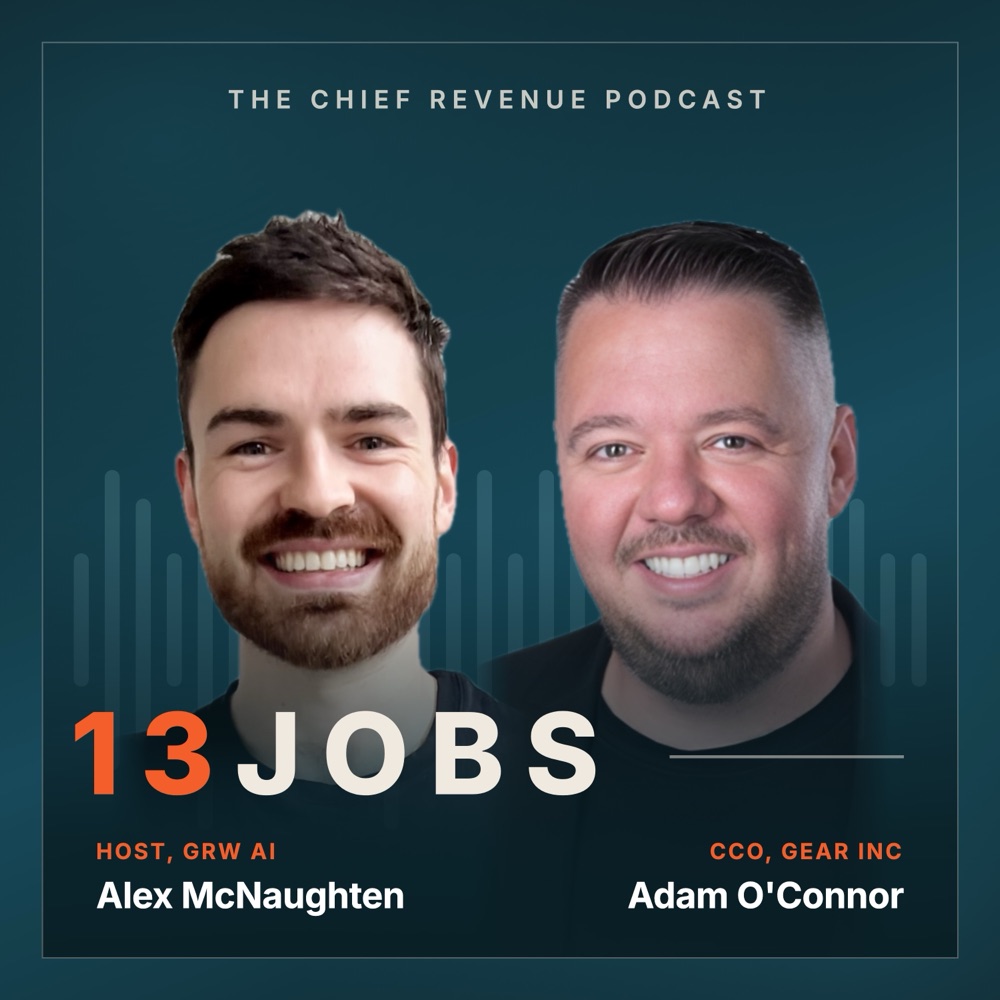
Building high performing global sales orgs
Eleven years building a sales team across four corners of the world. Adam on trust, cultural range, and why every region is really several markets.
 Hosted by Alex McNaughten
Adam O'Connor · CCO, Gear Inc
Adam O'Connor is the Chief Commercial Officer at Gear Inc, where he leads global sales strategy, drives revenue growth, and builds strategic partnerships across North America, Europe, and Asia-Pacific. With over a decade of experience in international business development and offshoring, Adam has scaled operations and optimized customer engagement across sectors like tech, finance, social media, and healthcare.
Previously CRO and Chief Sales & Marketing Officer at Cloudstaff, Adam brings deep expertise in BPO, content moderation, and trust & safety. A regular voice in the outsourcing community, he's been featured on the Outsourcing Fit podcast, sharing insights on leveraging global talent and navigating the complexities of digital operations.
In this episode, we discuss:
- 1.From a hotel job to the Philippines: the accidental route into sales
- 2.Three months that turned into eleven years, and a global team built from scratch
- 3.What actually made him good enough to be pulled out of the hotel
- 4.The rep-to-manager jump: unlearning the assumption that your way is the way
- 5.Leading leaders, and why trust is the whole job
- 6.Six or seven markets inside the US alone, and how China differs from Australia
- 7.Running a team across time zones, and what COVID permanently changed
- 8.Pairing reps across regions by industry so the knowledge transfers
- 9.The moment the team started helping each other without him
- 10.The mentor who found him, and what made her the best seller he has met
- 11.Knowing when it was time to leave after more than a decade
- 12.Learning to say no to the customer who isn't a fit
- 13.What he would tell himself on day one: do the research first
Quote of the show
“You can have a 2-hour conversation with somebody about how their life's going and then the last 10 minutes of that meeting might be about the sale, and persevering through that. Whereas the Australian market are very direct, and if they don't like something, they'll tell you.”
Key takeaways
- The first management lesson is unlearning yourself. Handing juniors your own playbook and expecting it to work is the default mistake. Different personalities sell differently, and the job is coaching to theirs, not cloning yours.
- Leading leaders runs on trust. The people running your territories got there on merit and carry experience you don't have. Marrying those needs together across cultures is the actual difficulty.
- One region is several markets. There are six or seven distinct markets inside the US alone. Lean on regional leaders for the cultural read rather than assuming a single motion travels.
- Match the pace to the market. In China two hours of conversation may precede ten minutes of business. In Australia they will tell you straight away if they don't like it. Neither is the wrong way to sell.
- Pair reps across regions by industry. Someone who has closed five healthcare deals in APAC is the fastest way for a US rep to crack healthcare. Both get a win and the team meshes as a side effect.
- You know the culture works when you're out of the loop. His measure of success was reps reaching out to each other directly, trading help without routing it through him.
- Not every customer is the right customer. Saying yes to revenue that doesn't fit hurts you and the buyer, who then won't try that kind of partner again. Define the ICP and hold it, especially early.
Transcript
Adam, thank you for joining the show. Good to have you here.
Thanks for having me, Alex. Great to be here.
And for those who don't know Adam, Adam O'Connor, you are today the Chief Commercial Officer at Gear Inc. But tell us a little bit about your background, how you got into sales and how you ended up where you are today.
Sure. So I've been with Gear Inc. about 9 months now. Previous to that, I had worked for another outsourcing company based in the Philippines. And my journey into sales is a little bit of an interesting one. I kind of fell into sales. I was working in a hotel in London. I met a lady who helped me with my studies.
She had just started a startup company in the outsourcing industry and asked me if I would be able to help her do some part-time sales just on a commission basis, and she would help me to pass my exams.
Okay.
Um, that started in 2011. Uh, within 3 months I had sold so much that she said, you have to quit the hotel and come and work for me. Um, that then led on to, oh, you should go and visit the Philippines where our company was based for 3 months just so you understand a bit more and things.
Uh, we'd also closed a reasonably large account that was starting in the Philippines.
Right.
So we went there, um, I went there for 3 months and ended up staying for 11 years in the Philippines and building the sales team to be a global sales team, um, and returned back to London about, uh, 3 years ago now.
Okay.
And ended up exiting that company and joining GEAR where I'm building the sales team and doing the same thing all over again. It's like a, it's like a replay. So it's fantastic though.
And just so I understand it correctly, you worked your way up from individual contributor right away to running the sales organization.
Correct. So I was employee number, I think about 36 with the original company. Started off as the UK-based account manager salesperson, got to the Philippines for that 3 months and because I was doing so well, asked me to help out with Australia and APAC. Built that up and then obviously added the Americas in as well and worked my way up as you said.
So that journey was a learning journey, learning how to control different cultures, different people, different personalities and working together with them. And it's been a fantastic learning journey along the way.
I bet. Before we get into the topic of building high-performing global sales organizations. I'm curious, I want to understand like what made you so good that you were able to, you know, go from IC and very quickly by the sounds of it progress into a whole, like a lot of responsibility. So like what made you so good as an IC?
And then the second part of that question is what then did you have to change or do to be a fantastic leader?
I guess it's quite hard when you turn around and say what made you so good because there's a number of things and it's quite a question that I haven't really thought about previously. But I guess my background in the hotels, I would work with everyone from the garbage disposal or bin men all the way up to royalty when I was in the hotels.
And you learn how to talk to different people and get what you need from different people and solution finder, essentially. So finding those different personalities and how to talk to them within the hotel sort of helped me when I came across into the sales team. I was selling to different people. And as you know, Alex, when you sell to different territories, the whole sales processes and the personalities that you're dealing with are completely different.
So I guess that background helped me to understand key points when I was trying to sell to different industries, different personalities, different cultures. And from there, obviously teaching people and helping people to sell, I guess the boss at the old company saw something in me and asked me to take on more responsibility.
And every time he did, I done well. And it comes to a point where they just add everything under you. I mean, they moved me to the COO role for a little while, but operations is a completely different beast to sales, and I prefer the sales, the hunt and the kill, as it were.
So.
Fair enough. Did you have to change anything as you, you know, I think, let me rephrase that question. Like a lot of people, I think, struggle with the rep to like first-time leader role. Like it's a jump and you sort of have to unlearn some things and learn some new things. What were some of the biggest things that you had to learn as you made that transition to leading a team?
You, you— one of the hardest things to do is to let go a little bit and to trust your team as you bring people in. Obviously, you're training people up, you're, you're trying to get them to do things. And when, when you're a rep, you have your own way of doing things. You understand this works for me, this doesn't work for me, how I talk to a customer, the kind of personality you are on different calls.
And bringing in a few junior guys who have now gone on to have great careers, the first guys that I brought in, I thought, oh, just do exactly the same as me, you'll be fine, it works for me, it's gonna work for you. And you kind of unlearn different personalities, different people have different ways of selling and they can all be successful as long as they have the right attitude, the right attributes, they can talk to people.
Lucky in the sense of I've sold services for the longest time in my whole career. I haven't sold commodities or individual items or consumer products. So we've been solution selling since the start of my career and that resonates with me because I believe in ethical sales. I believe in the fact that the services that we provide are low margin and higher volume means that the only way that you continue to make money as a sales rep in commission is to keep that relationship going and learning that people have different ways of building relationships with people was probably one of the biggest learnings I had out of that jump up.
Right. As in like the different members of your team had a different style and a different way of doing things and you had to hold back the—.
Hold back the want to say, no, do it this way, do it this way because you have your own way of doing it. So yeah.
And then Talk to me around when you like took that jump from like frontline leadership to then now you're leader of leaders. What was that transition like? And again, what did you learn about during that transition?
Trust. You trust people. I mean, the leaders that you bring in to run different territories, different departments and things, they're there on merit and they've gone through experiences as well. I still learn every day, Alex, from people, even in the position I'm in now. I mean, I have— I'm very fortunate. I have a great team.
We bring together lots of different cultures from across the world, but everybody has their own experiences. Everybody has their own needs and wants as well. And trying to marry all of that together within the team can sometimes be a bit of a challenge. And understanding, getting everybody together when they're in the 4 corners of the world as well can be a bit of a challenge.
But they You have to trust the people that you bring in. You have to have the foresight to know that these guys have gone through the same as you have, maybe not up to the same scale, but they've gone very high up and they've learned they can train people, they can guide people, they know how to do it.
What might work for you in terms of sales huddles and how you run things might not be the same way it works for them. And again, sitting back a little bit, understanding, having them do the reports, reading the reports rather than jumping into sale and say, right, this is how I'm gonna close it.
Again, it's another transition, but it works. It works.
And then when you add like a global lens across all of this because you're operating and you still are, you know, but across both your roles, been operating around the world in lots of different markets. What were some of the lessons you've learned from how you approach different markets? Because I know like, you know, My goodness, like we sell into different markets and there are definitely challenges, you know, in the US that we perhaps don't face when we're selling into the ANZ region or vice versa.
So I'm curious, yeah, what any lessons there?
Well, even if you just take the United States for an example, there's probably about 6 or 7 different markets within just that one region, how you sell to people, how you approach them, how you deal with the challenges. So I lean on my leaders a little bit for the cultural essence within each region that they're selling into.
I mean, when I first started selling into China, I hadn't done it before and to understand that you can have a 2-hour conversation with somebody about how their life's going and then the last 10 minutes of that meeting might be about the sale and persevering through that. Whereas the Australian market are very direct, and if they don't like something, they'll tell you straight away, which is a breath of fresh air for me because I like to know exactly where I stand, how I can fix things.
The British market might beat around the bush for 2 or 3 meetings and 2 or 3 messages before they actually get to the point that they want to tell you. So learning all of those little niche cultural nuances Is is something that you you get guided by people who have more experience than you.
Even even now, as I say, I learn every day from my team. There are things that they are aware of much more than me, and we we try to bring all of those elements in.
We we fester a a team culture, whether that's What about some of the challenges when you're, when you're building a team across different time zones, different countries, different markets? Like, I know from, you know, our own business, but also companies I've worked with in the past that it can be quite challenging to build a high-performance culture when you're not in the same room all the time.
Correct.
What did you do in order to help foster that kind of performance culture?
20 years ago, it was a lot harder than it is now. Technology has come such a way and the unfortunate events of COVID meant that the whole world learned to work remotely as well. So we're in a now day and age, people have learned how to do it. But previously when we were running, we were building the company, we would have Weekly meetings.
We created Slack channels where people would put in their challenges, so everything was going around. And one of the biggest challenges is we only have 24 hours in a day, and we have to rest at some point as well, even though that's that's a premium when when you get into the higher levels of management.
But again, it comes down to making sure that you're available when you can be to your team, making sure that you. Are very clear with your instructions, trying to have a weekly meeting where you bring everyone together. Obviously, time zones can be a challenge, but you find the time where it can work for everybody.
I think creating that culture and building that camaraderie between the team so that everybody's helping each other, although you have your individual and you like a little bit of competition within the teams because everybody wants to be the best, you still want to garner a camaraderie between the team, that the company wins when somebody wins.
Even if you are beating, say, APAC's beating the Americas or EMEA's beating APAC, whatever it may be, you still want the friendly rivalry rather than it being a cutthroat kind of team because people won't last or flourish within that kind of team.
Were you able to foster good collaboration between those different regional teams. What are some of the things, what are some of the ways you were able to do that?
So although you'd have different regions, the different sales reps and leaders would have sold into different industries and have niches that they've done previously, right? Would help them get to know each other. Bringing them together on a project would also enable a bit of cross training from the guys to help them build up.
So for example, if you were selling into the healthcare industry in the United States, but somebody in APAC had already closed 4 or 5 deals within that industry, we would work out a way that the 2 reps could work together, transfer some knowledge, both get a win, both work together and you'd kind of start meshing the team together that way.
And from there you would then have, uh, in person as well, as long as they were performing and we could afford it, of course. But, um, they tend to do that and they tend to do really well. Um, and, and just working with channels like Slack, um, Mattermost, there's, there's lots and lots of different sort of similar kind of products that, that bring everybody together and, and get real-time input from each team member.
What you just said there seems really obvious. It's like if someone's worked on healthcare in one region, buddy them up with someone who's maybe trying to crack into healthcare from another region. It's amazing how that doesn't happen in organizations as they grow. I think it's easy when it's a team of 20 or 30 or 50, gets a lot harder as an organization grows.
Did you As the business grew, like, did it get harder to foster that collaboration, or did you just ingrain it from day one and then it just kept going?
We ingrained it from day one. And going back to the culture that you build with the team, I, I was kind of cut out of the loop towards as, as we started growing, because the guys would just reach out to each other and say, hey, can you help me on this? I'll cut you in.
Or, can— do you mind helping me with this? I help you with this next time. And things like that. And it just became the culture within the team that we would all help each other. Um, and, and that really was the key to us being so successful and pushing through with everything.
You've mentioned something a few times, you've reiterated a few times during this conversation is that you're still learning and I love that. Who were some of your biggest mentors along your journey and what are some of the lessons you learned from them? Like the key lessons.
So the lady I mentioned first who found me in the hotel, she was obviously the biggest mentor I can have. To be honest, Alex, she's probably still the best salesperson I ever met in my life. She actually stepped out of sales and went into cybersecurity and stuff after she brought me into this company.
But—.
What made her so good at sales, Adam? Before we move on, I'm just curious, like what made her so unbelievably good?
She was ruthless in the nicest possible way. The sale was the most important thing to her. So she would bend over backwards to get that sale. Methodical in the whole sales approach, whatever sales methodology she was using at the time I met her. She was using Spin Selling by Neil Rackham and I still use the same thing.
It may be old now, but I, you know, you've got the Challenger Sale and everything on top of that, but Spin Selling still seems to resonate very well with people, especially in solution selling. Um, and she was just really, really good. She would, one thing sales guys aren't very good at is filling in CRMs, following up in a timely manner, all of the admin kind of side of things.
They like to talk to people, get the signature on the thing. But she, she really drilled into me the importance of the admin side of things, following up when you say you will, making people trust you, understanding that when you say something to someone, it's a promise. And follow through on that promise because trust takes a long time to earn and a second to lose.
And that's one of the real key learnings I got from her.
So. I think that's also a skill that applies to selling, but then also leadership too.
Agreed.
Agreed. And I've noticed that sometimes amazing salespeople, when they move into a leadership role, they forget all of the things that made them an incredible salesperson. They don't do it when they're coaching their team. And like that one that you just highlighted is so crucial. Um, and then further on, as you, as you progress through your career, like, who are your mentors now?
Like, where are you learning from now?
I, I, in a, in a weird— I learn from the team most, most of all. I learn from the team. And what I mean by that is experience teaches you— we all make mistakes, Alex. Experience teaches you what you shouldn't do next time or how you could handle that situation a little better in the future.
What you can say in the situation, how within a sales team of 50 people, you have 50 different personalities. Some people need a kick up the bum, some people need an arm around the shoulder, some people need to be coached on this certain thing. Some people are lazy, some people have really great work ethic, but they're not, they don't have the same bond or relationship skills as some of the other guys.
And learning how to try and get the best out of everybody so that they can be the best that they can be. Me is probably the biggest thing that I would say as well.
Slightly random question, but how did you know it was time to leave your last role when you'd been there so long? Like, what was the moment for you when you were like, okay, I need a change?
So I moved back to London before I left my last role. The company is fantastic. I really enjoyed the company. I love building it up. As I said, I was a very early employee and by the time I left, we had nearly 7,000 staff. And when I was back in London, the CEO called me one day and said, I want you to move back to the Philippines.
I just bought a house, I just bought a car, I was sorting everything out in London. I said, look, I can't do it. It's not what it was before. Now I'm building my life in London. I don't want to give all of that up. And he said, well, if you don't come back, maybe we have to have a look at a solution.
And that's kind of why and how I left there. But I also thought that I'd grown on my journey and it was probably the right time for both of us to look for a new challenge as it were, or new leadership on the other side. So.
Right. Yeah, I think it can sometimes be difficult, right? When you've, and I've spoken to a lot of leaders who stay, you know, who've come up in an organization and, you know, it can be difficult to know when the right time is Yeah, it was, it was, it was definitely the right time for me.
It was, you know, it was, I think, the right time for both of us as well, the company to move on to different leaderships, try new things, and for me to go and spread my wings a little bit, as they say, and see what else was out there and what I could do.
And, you know, now you've been in your new role for a little while, like, what, what made you join that company? And what's it, you know, what are you excited for in the future?
6,000, 6,500 people without ever having to say a word, which is amazing. But they were— it was almost like a fresh canvas to go in and build the team from scratch and do what I feel is what I'm best at and foster the right energy, foster the right relationships, get people going, learn how to teach gear and the reps that I was bringing in how to go out and sell and bring new customers in and make sure that you're looking after those customers because they will refer other customers to you and they will grow with you as you do that.
So.
Exciting. So sort of an opportunity to take all the lessons you've learned from the first run and then, you know, do it but even better this time around, probably with fewer mistakes that you probably made on the first time, right?
That's the plan, but not everything always goes to plan. But yeah, that's the plan to do it with less mistakes. This time.
What were the one or two biggest mistakes you made along your, you know, along your sales journey?
I think when I got into leadership, I wanted to say yes to every customer. Not every customer is the right customer because you want to look great because you brought all of this revenue in. Some customers just aren't a fit for the companies that you're working for. They might be better suited to other people and that's not because they're a bad customer, it's just that the kind of relationships and work that you're doing don't necessarily fit.
I learned to be a little more selective in saying, look, I think you'd be better off going with a different company because we do it this way. I don't think that's gonna fit with what you want to do rather than chasing the revenue in the situation that we were in. So, which is always quite a delicate balance as well because you've got a CEO who wants all of the revenue they can get.
The CFO is shouting at you, you need to get this, but you need, if you bring in the wrong customers, it can affect morale of the staff, it can affect morale of the salespeople and it can affect a lot more. So revenue is not always the number one target.
Because it can be a short-term win, but it can also be medium-term pain or long-term pain.
That's right.
Exactly. So yeah, being disciplined on qualifying the right kind of customers can really make sense.
Defining your ICP and making sure that you kind of look for that and you don't waver too much from your ICP in the initial stages, especially because If you're targeting, I don't know, and I'm using this example, not myself, but if you're targeting just accounting firms to try and help them and then somebody comes in from the software development firm, logic should say to you, that's not the right customer.
You don't have the expertise, you can't do it. But so many companies say, oh, let me try and figure it out for you and things. And it just ends up in pain, not just for you, but also the customer and the customer won't then try it again because they tried it with the wrong person.
It didn't work and they just think this isn't for me. So yeah, that's it.
I've got one more question for you, which we ask every guest who comes on the show is knowing everything you know today, you've been in sales and sales leadership for a long time, go back to your very first day on the job in sales. What's the one piece of advice you would give your younger self?
From the initial, from the first day, it's a great question. I would probably say research, understand your customer. In this day and age, when a customer comes to sell to you, they already know you, they already know everything about you. It's all found online. They have the advantage within the negotiations because they know everything.
You should know Obviously, if they call you out of the blue, have the conversation with them, but then go and do a little bit of research before you go and try and find the solution and sell and everything. Understand what the problem is that they're trying to solve. Understand the person that you're selling to and try and foster that relationship that way.
I think when I was first on, and sorry for the long-winded answer, but when I first started in sales, I think I was so eager to please and so eager to get the the revenue in that maybe I didn't do the research and foster those relationships even as well as what I could have in this day and age.
So that would be my—.
I think it's great advice and I think it's actually like the bar for that has actually risen because of how connected we are and, you know, AI and how much information's out there is that the expectation is that if we're meeting for the first time is that if I'm the salesperson, I should have, I should know a little bit about you already.
And, you know, I, I, it's, it's not difficult to spend the extra 5 minutes, um, but it makes a huge difference to someone's performance.
Absolutely.
So I think that's a fantastic piece of advice. Um, Adam, great conversation, and you've had phenomenal experience and, um, probably quite unique experience actually, the way, you know, you've, you've, um, you know, worked across so many different markets. Where can people find you if they want to connect with you? And is there anything else that you'd like to share with us before wrapping up?
Yeah, so they can go to the company website, which is www.gearinc.com. They can find me on LinkedIn, Adam O'Connor under Gear Inc. And if they reach out either of those, I will see both of them and they can connect with me there. We're working very hard. We're doing ethical selling within the outsourcing industry, looking to help people cut costs but still keep the same kind of skills.
And that's what we're doing. But thank you so much for having me on, Alex. I really appreciate it and it's been a great conversation.
Likewise. Thanks a lot for your time. Thanks.