
Organizational sales health
Buyers say they'd rather do it alone. Aaron on what a seller has to be worth now, and why coaching is the muscle most businesses never built.
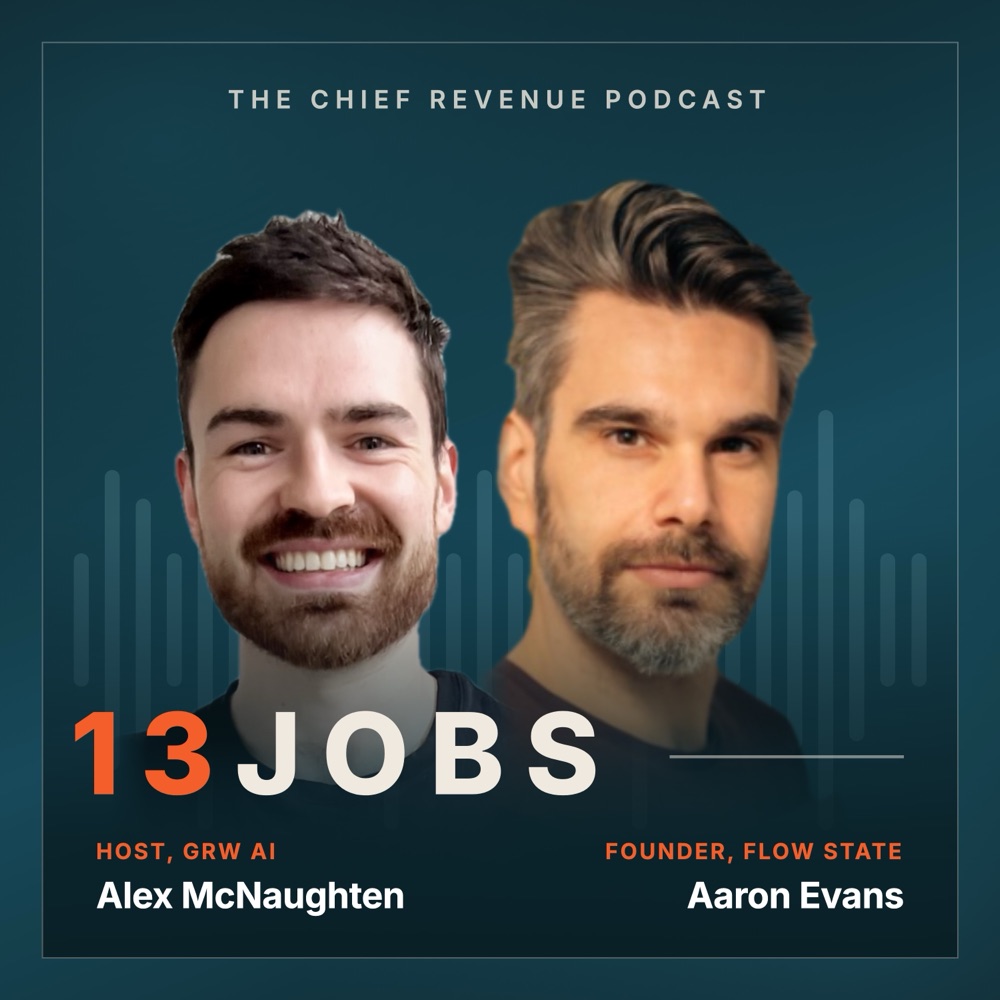
 Hosted by Alex McNaughten
Aaron Evans · Founder, Flow State
Aaron Evans is the founder of Flow State, a specialist B2B sales performance and transformation consultancy dedicated to helping leaders and teams win in the new era of B2B sales. With 14 years of sales enablement, coaching, and hands-on training experience, Aaron has worked in multinational, corporate, and start-up business environments across EMEA, US, LATAM, and APAC.
Throughout his career, Aaron has successfully led sales transformations in several verticals, including taking an HR tech business to IPO in 2014. As a qualified coach and practitioner of NLP and Neuro-Semantics, he brings a unique perspective to his work in sales enablement.
Aaron is a passionate SaaS sales enablement leader, guest speaker, and mentor who has proudly developed thousands of sales managers and professionals globally. His expertise lies in creating highly-immersive, bespoke B2B sales training and coaching experiences.
In this episode, we discuss:
- 1.Why sales enablement exists at all, and what that says about the problem
- 2.A generation of sellers who only know the SaaS growth model
- 3.What buyers now want that most sellers can't deliver
- 4.The revenue-at-all-costs hangover, and the capability that was never built
- 5.Why we're talking: expertise as the reason a buyer takes the call
- 6.72% want a rep-free experience, and what that demands of you
- 7.More information does not mean better informed
- 8.Becoming an expert is a daily discipline, not a course
- 9.Slower cycles, more stakeholders, and what that does to forecasting
- 10.Email volume up 70%, response rates down 30%
- 11.Pastry chef to grill chef: promoting reps without teaching the new craft
- 12.Why the coaching failure belongs to the business, not the manager
Quote of the show
“72% of buyers said they want a rep-free experience. So the bulk of people are sitting there going, you have no value in this process, zero value whatsoever. I'm better off doing this on my own.”
Key takeaways
- Buyers would rather do it alone. Nearly three-quarters say they want a rep-free experience. The seller's job is to be visibly worth the interruption in the first few minutes.
- Expertise is the only durable differentiator. The buyer can get information anywhere. What they can't get is someone who has seen their problem fifty times and can tell them what happens next.
- More information hasn't made buyers more informed. Eleven stakeholders and endless content produce paralysis. Helping them decide is the value, not adding to the pile.
- Expertise is a daily discipline. Dedicate part of every day to listening to customers, codifying what you hear, and turning it into a point of view.
- Promotion without retraining is a category error. Handing a pastry chef the grill doesn't make them a grill chef. New competencies need scorecards, coaching and tracked improvement.
- Most businesses can't define coaching. They conflate coaching, mentoring and training and assume it's happening. The fix starts with defining it, not blaming managers.
- The channel got louder and worse. Email outreach up 70%, response rates down 30%. Volume is no longer a strategy, and hasn't been for a while.
Transcript
Aaron, good to have you on the show. How are you?
Very good. Thanks for having me. Big fan of your work, obviously a big fan of what you guys are doing over there at Grow.ai as well. So yeah, excited for our conversation.
Likewise. And for those of you who don't know Aaron, you are the co-founder of FlowState Sales, but tell us a little bit about yourself, your journey and how you came to doing what you're doing.
Yeah. So, well, interestingly, my journey kind of touches a part of the world where you are as well, right? So I started in sales actually working in retail many, many years ago when I was a spotty teenager selling wooden toys to incredibly rich people and it built a bit of a kind of curiosity in me about sales and how selling works.
And then I was really fortunate to go and work in B2B. I was working for a huge multinational publishing house called Reed Business Information on a few of their magazine products. And for the young viewers out there, magazines are these paper things that we used to read before the internet came around. And I was selling advertising space on that.
And interestingly, at that time, I was right in the middle of online disruptions. This was when the internet was becoming a more viable option for advertisers, when things like money was being exchanged over the internet, which feels like a really novel thing, but we do it so automatically now as well. So I was on the precipice of this disruption and it taught me a ton about sales, about how sales organizations work as well.
Now, more crucially, in that time that I was working for a business this information. They heavily invested in training. So the first month within the job, it's pretty intensive training. And also you go through certification to demonstrate that you can even do the job, which again feels really foreign in 2024. Um, but during that stage, it sort of, um, it got me really passionate about selling, the time that I was there, and it got me really passionate about helping sellers sell better.
And I kind of fell into training, um, really early in my career. So I'd only been selling for about a year or so properly until they started giving me some responsibility of training and coaching other reps. I managed to make a bit of a name for myself in the organization when I moved over to Australia, which I know isn't where you live, but it's very close to where you live.
Close.
And then moved out of B2B publishing and moved into SaaS. So I've spent the last over 10 years now in my career working in SaaS organizations in what's now known as sales enablement, but at the time was known as training and L&D. Yeah. Helping coach, train, develop. And sort of sum it all up, I'd started my own business 3 years ago with my colleague Rafael Fernandez, who again, we've been working together for about 20 years on and off for different organizations.
And we found a gap in the market of like proper hands-on coaching and training and not just like getting into a classroom and here's some ideas, but actually let's try and infuse this with live pipeline. And this felt like a real gap in the market. No one was there going, all right, let's train, but let's do it on live opportunities and pipeline and start influencing those deals.
So we started that organization 3 years ago and we've been really fortunate to work across the globe for lots of different businesses like Amazon, like LinkedIn, like Monday.com, all the way through to really small disruptive players who are trying to, you know, agitate the big players in the market as well. And all the way through to today, here we are, we're discussing it.
It's an exciting journey you've been on and I think we sometimes forget that sales enablement is new, like it You know, you're so right, you know, back when I started in sales, it didn't exist. It was, yeah, training. And then also, I think you pointed something out that is interesting is that like that idea of intensive training when you join an organization, like intensive, you know, a month certifications, that doesn't, that's not the case anymore.
And it sort of brings us on to the topic that we're gonna discuss today, which is the sales health of organizations. And I want to start us off just quite broad. It's like, what are you seeing? You know, you're helping a lot of companies, but broadly speaking, what are you seeing in the market?
Yeah, I mean, loads of challenges. I mean, by virtue of us even being there shows you that there is a bit of a challenge in the first place, right? I mean, if it was all harmonious and everyone was kind of adhering to best practice, we wouldn't have a job. But again, I think you've got to go back and kind of collect the tool to really understand this is that Predominantly the work that we do is in SaaS, which has gone through seriously rocky times over the last 2 years.
But again, we can kind of talk about that in more detail, why it's in that position. But we also work for a lot of businesses that are kind of digitalizing as well. So there's a ton of disruption and they're in some ways late to the table to digitizing. So they don't have that kind of rigor and robustness built into their sales organization and they're kind of operating in an old-fashioned way.
But if we kind of focus on SaaS, I mean, look, SaaS has been through like some halcyon times over the last 12 years where basically you could go and hire someone who typically would have gone and worked in retail 10 years ago. Well, now you're a salesperson in SaaS and guess what? All you've really got to do is turn up to these leads that are flying through the door, talk a bit about our products, offer a price.
They don't like the price, give them a 20% discount and then hang them and harangue them until they buy our products, right?
And we've kind of confused that with selling where like, ah, this is what selling is.
So we've now got this, this huge part of the market, which is these young sellers who've grown up with this way of selling, which is basically the SaaS model, which is I'm gonna pepper you with emails and then I'm gonna finally get you on the call. And when I get you on the call, I'm not gonna show you the product.
I'm gonna ask you the same 6 questions I ask every customer to essentially qualify if you are right for me. And then when you've qualified me, I'm gonna give you a demo, which is basically a training session on our product. I'm gonna give you a price and then I demand that you make a decision today.
And guess what? You might close some of those. And if your product's good enough, you will close those. But something happened 2 years ago where customers turned around and went, oh shit, the economy's in tatters. And post-COVID, we've gone and bought all of these tools and we don't even know if they're working.
We don't even know what the ROI is. So now we're trying to use that same old playbook and the customer's turning around and going, I'm not buying something that's nice to have for 50 grand a year. Are you crazy?
Yeah.
This has got to demonstrate that it's gonna significantly move the needle on my business. Now, what the buyer wants from the seller, the seller can't do, which is come into my business, challenge my perceptions, tell me where I'm wrong, tell me where the problems are, tell me where the icebergs in the distance are, help me look around corners, be the expert in this conversation so eventually I can go and convince the 11 other stakeholders involved in this buying decision that not only do we need to solve this problem, we should prioritize it, but it's going to have a significant impact on our P&L if we solve it.
And the seller's sitting there going, oh, I can give you a 10% discount.
Yeah.
No, you can't. That's not how it works, right?
Yeah.
So it feels like those days are well and truly over with SaaS now. Um, and here, here is the problem, the biggest problem. I don't blame the seller, is that we've had this revenue at all costs mentality with, with SaaS, which is like, I don't care, just get the deal done. We've got investors breathing down the neck and they want to see growth.
Let's go and get more investment. Well, the investment's not there anymore, the growth's not there anymore, and the sales organizations are sitting there scratching their heads and going, How do we do this now? It's like we don't have the capability, the muscle, the competency, or even the management structure, or even in some cases the leadership to go and do this.
And I'm not just talking about the sales leadership, but the bedroom entrepreneur who was successful for 5 years is now sitting there going, I need to get Series C, but we can't keep our customers happy. They're not renewing and AI is coming and eating our lunch. Well, yeah, you should have built a proper sales force, right?
That's what you should have done.
Well, what you've just— no, it's a brilliant answer and it's actually, it's taken me back to, you know, years ago when I was an account exec selling software and doing 5, 6 multi-six-figure deals with one stakeholder exactly as you described, you know, and it's like, good luck trying to do that today because it's exactly as you said, it's like now you've got 10, 11, 12 stakeholders, everything's by committee and you've even got to earn the right to get in front of that committee.
And that was the bit I was gonna ask you about is, How do we get salespeople who have been, you know, effectively trained the way I was trained, which is, you know, sell at all costs. If it's not moving, discount it, you know, like how do we get people to go from that to earning the right even to be in the conversation?
Because that seems to me the big gap right now.
So it's really interesting, right? I'm gonna give you an example of that, right? And I'm going to ask you a really simple question. Why are you and I talking now?
We got connected through someone that we both really trust.
Yeah. And they said, you should speak to this person. They know what they're talking about. They're an expert. Then you and I got talking, and then we were like, oh, this person knows what they're talking about. I can learn something from this person. I assume, I assume that's reciprocated.
I don't know.
I just want to let your audience know.
Definitely reciprocated.
And all of a sudden it's like, okay, there's, there's like, you wouldn't have me here if you felt that you know way more than me and, and your audience knows way more than me. There's, there's clearly an information asymmetry where it's like, this person's an expert, I should listen to what they're saying.
And again, this isn't about me, I'm not saying I'm some big expert, right? But this is how we got— the seller needs to think about this in context of the buyer, which is If I'm turning up to a meeting now and the buyer's done even a 20-minute Google search and they know more than me, I'm completely superfluous in this interaction.
Hmm.
And this is borne out in statistics, right? 72% of buyers said they want a rep-free experience. So the bulk of people are sitting there going, you have no value in this process, zero value whatsoever. I'm better off doing this on my own. It would be easier, it would be quicker, and it would actually be more effective if I did it on my own.
So the point here is that we've got to very quickly show the buyer that we have deep, deep value in this process, right? I'll give you another analogy, right? When I see a dog, I scratch them in places that they can't scratch themselves and then the dog keeps coming back because I can do something that it can't do itself.
Yes.
And then it sees value in what you're doing. This is why dogs start doing that thing when they start like, you know, vibrating, because you're scratching them somewhere they can't scratch themselves. And this is what we've got to do to the buyer, right? That we've got to show them something, we can give them something they can't do themselves, right?
And again, we can't talk about selling unless we talk about buying. And everything I'm about to say now is not unique, but it's true. 11 stakeholders involved in a B2B buying decision. There's never been more information available to buyers.
No.
Just because there's more information, it doesn't mean that they're more informed. So we've got 11 stakeholders involved in a buying decision, we've got loads of information, we've got the fear of messing this up, as you know, Matt Dixon's written in great detail in The Jolt Effect and talks about it in great detail as well.
So there's this environment now for sellers where making a decision is almost impossible. If you think selling's hard, try buying.
Yeah.
I mean, try buying a holiday, let alone going and buying a, you know, quarter of a million B2B decision, right? Buying a holiday is like, I don't know whether the hotel is going to be good, I can't really trust these reviews, they're so mixed, what if the food's not right, what if our plane gets delayed?
It's impossible. Then you've got 11 people trying to navigate an internal buying process. That's impossible. So all of a sudden you sit there and you go, well, what value can the seller bring to this process? Well, number one, they've gone through, they've gone through this a million times, so they can help us go through this process.
They can help us be confident in the decisions that we're making. They can help us make sense and curate all this information because all I've got is like more white papers, more like, you know, top 10 lists. More like things you should think about when you're buying this, like articles. Really what I want someone to do is ignore the bulk of that, just read these 3 articles, forget about us, forget about your purchase, this is going to help you organize internally.
So the key thing here, right, and there's no shortcut to this, is the seller has to become an expert. Expert on the problem, expert on the macro and micro trends, expert on buying, expert on the challenges and the impacts if these problems are left unresolved, because this is what the buyer wants from the seller.
And you're now going to ask me, how do you do that?
Well, you just take one pill a day and you wake up in the morning and then you're an expert. No, that's not the answer, obviously, but that's what we wish the answer is. And what we always say to people is it's like going to the gym. You don't just turn up once and then expect to have a six-pack.
Yeah.
Every single day you dedicate a portion of your day, the discipline, the rigor of becoming an expert. You listen to what your customers are saying, you codify it, you build your own opinions, you talk to more people, and within a year, 2 years, you'll turn around and go, oh, do you know what, I actually know quite a lot about this.
And then you become more passionate about it, then you talk more passionately about it, and then your buyers buy into you and go, we should really speak to this person because they know what they're talking about. Again, a bit of a downer.
No, but I think like there is where I see part of the problem right now. Because you've got the expectations of the seller have gone from here to here. Yet we expect salespeople and we model how we build a sales function on the assumption that we're gonna ramp them up in 3 months.
Yeah.
And, you know, that to me, and then you've got the tenure challenge where they're gone at month 14.
Yeah.
So it's like, well, how do you then make someone an expert and then keep them in your business? And, you know, that's a very big topic, but like, that's the immediate challenge I see as soon as you said that to me. It's like, well, we probably need to rethink how we, you know, onboarding salespeople then.
Yeah. And that's precisely what we do with businesses, right? Is that there's a reality check, which is at some point, you've got to come off the hamster wheel.
Yeah.
We know certain things are happening, right? Which is deal cycles are slowing down. So gone are the days when you get someone to make a decision in like a week. It's just even $10 grand, someone's not gonna be able to make a decision in a week. It's very rare that people can make a decision in a week, even in big businesses now.
And the CFO's getting involved in like bog roll, which should go down to 2-ply instead of 3-ply bog roll, right? It's like these decisions aren't made immediately anymore, right? So we've gotta appreciate, okay, fine, well, if our sales process, which is really the buying process, is slowing down, Maybe this is the realization that businesses have, which is we need to kind of move up the value chain, right?
So we need to move from this transactional quick sale to actually our products when positioned right can move the needle on your P&L and ultimately, you know, solve bigger problems. And if it solves bigger problems, it gets access to more influential people, gets access to more budget, you know, all the things that are around making bigger business decisions.
So that's problem number one, is getting people to translate operational pain and technical pain into what we call kind of, you know, overarching business pain or strategic pain. So that's problem number one. And then when you start thinking we're going to sell like that, there are other problems, which is, well, look, we've got to now organize our business to sell like that.
Well, what does that look like? Well, first of all, this tactic of just spamming people every day with email using these spam cannons, like, you know, these outreach tools, Yeah, spam cannon.
I like that. It's exactly what they are.
I mean, there was a staggering statistic which was over 2001 after COVID, email outreach went up by 70% and response rates dipped by 30% when it went up by 70%. So the buyer keeps saying to us, stop emailing me, and we keep going, okay, cool, we'll send you more emails, right? So we've got to be more, we need to be more intelligent about our outreach, right?
Which is presenting more problems to the buyer, earning the right to be in these channels, using other ways of getting in front of them, like, you know, video, LinkedIn. I mean, in many ways, outreach should be kind of your plan B. Plan A should be about building your expertise through things like LinkedIn and events and conferences and exhibitions and becoming a bit of a face and a bit of a name in the industry, right?
And being known for what you say. So let's kind of park that side of it. But the second part is actually, how do we now organize the infrastructure of our sales organization to do that, right? So, We need defined pipeline gates, right? So we need to be strategic about this. We need customer-led actions.
So whenever a customer does something, that's when we move our opportunity, not when we do something. Can't just go, oh, we're gonna send you a proposal, therefore we've decided you're now a late-stage opportunity. It doesn't work like that, right? This is customer-led actions. But then for us, the most crucial part and where we probably help businesses the most is, well, how do we build the rigor around management and coaching?
Yeah.
Because managers really are the kind of custodians of this. So we help people with things like robust deal and opportunity scorecards so they can look at this objectively, remove the rose-tinted glasses and get coached around opportunities and build proper strategies to go and influence opportunity as well, right? Then it's defining this new set of skill and competency that's involved in this new way of selling because if you're going to turn around and go, we're changing the way we sell, that comes with a different set of competencies.
Yeah.
It's like me grabbing a pastry chef and now saying, well, good news, you're now a grill chef. It's like, well, They're different skills. We're still chefs, but we're different skills. So we now need to kind of rigorously, and again with this word of kind of like discipline as well, coach and train people on these new competencies.
So we help them with things like competency scorecards so they can not only use the right exercises to coach these muscles, but also track the improvement of the coaching outputs as well. So it's not just about coaching, it's seeing where the coaching is being effective. Yeah, so for us, there's 2 languages that we bring into organizations, and this is what we recommend.
There's the language of pipeline. So we need them, everyone in the business speaking the right language of pipeline once that's been defined. And then there's the language of people, which is competency. So get everyone in the organization speaking the language of people, the right skills, talking about the right competencies. And then all you do is you just flood this with coaching, constant quality coaching, making sure the managers are coaching at scale.
What we don't touch is things like positioning and go-to-market. Like, yeah, that should happen outside of that, right?
Yeah, the coaching piece is really interesting. Obviously, I've got, you know, what's a horse in the race, so to speak, when it comes to coaching. And look, the stats on coaching at a macro level are atrocious, right? Like 10% of salespeople are getting regular coaching. About a third of salespeople are getting any, yet 80% of managers think they're coaching.
What is that gap? Like, is it that managers don't know what coaching is or they don't know how to, or like, yeah, what are you seeing?
All of the above, but the accusation should really be leveled at the business, not managers, because most businesses don't know what coaching is.
Right.
So they, they conflate coaching, mentoring, training, and, and they think that they're doing it. So the first step that we do is we actually help them define what coaching actually is. Because you'd be amazed, managers who've been doing the job for 15 years, which in itself is a rarity nowadays, and you grab them and they go, well, what do you— what's your definition of coaching?
It's like, oh, you know, like telling people what to do. It's like, no, that's not what coaching is, right?
So what is coaching?
Coaching essentially is enabling someone to come up with a strategy to go and execute themselves.
Okay.
Through the way that you get them to think about the problem and the questions that you ask, essentially is all it is, right?
Right.
So, so a live example for your audience now, and I'll bring it out of context, is that if you imagine that Alex came to my house and we were having a dinner party and Alex said, I've bought you a lovely bottle of red wine, where's your bottle opener? The easy thing for me to do is go, oh, it's in the 3rd drawer down of the kitchen drawers, right?
Alex goes in there, finds the bottle opener, opens the bottle of wine, has a glass and enjoys it. But he's not learned anything in that process. We think he's learned something because some knowledge has been transferred. But as we know, only about 20% of knowledge actually sticks.
Yeah.
Um, when you're trained on something, the smart thing to do and what coaching is, if Alex came to me and this would be a very, you know, boring conversation at a dinner party and said, I've got wine, can I please borrow your bottle opener? I want to get him to come up with that answer himself, even sometimes if it's not the right answer, because I don't always know.
But I might say to Alex, well, where do you keep it at home? He's like, well, in the drawers in the kitchen. Well, which drawer? Well, first drawer's cutlery, second drawer's tea towels, probably the third drawer down. Why don't you go and have a look and see if it's in there? Alex goes in there, finds the bottle opener, opens it.
He's learned something. Now this is where it becomes really exciting. 10 minutes later, Alex sees a pile of walnuts on the table, but there's no nutcracker there. So now Alex's instinct is not to go, oh, Aaron, where's your nutcracker? His instinct now is to go, where would I keep my nutcracker? So you teach someone a way of solving every single problem through the way that you create coaching moments in their mind.
Yeah.
What we think is if we give someone the answer, they've learned something. We know that doesn't work. Ebbinghaus proved this 100 years ago. Only about 20% of it sticks. When you add coaching into the mix, that knowledge retention jumps up to 88% because you're giving them a problem-solving framework in their mind that they have the autonomy and the agency to own themselves.
So that is probably the purest and simplest definition of coaching.
I really like that. And what it reminds me of, something I used to say to sales managers and sales leaders is I would say to them when it came to developing their team, I'd say, go slow to go fast. You know, like slow it down, like take the extra few minutes to do exactly just as you've described, which is actually don't just show them, like coach them through it because then you actually engage their brain to think about the problem.
And then you don't build, then you build self-reliance, not reliance on you. And I think a lot of managers kind of create this rod for their own back, which is they just have sellers coming to them constantly with the same problems again and again and again, week in, week out. And managers do what they feel like is the simplest thing to do, which is like save the day, get involved, jump in, point out what the answer is rather than taking the extra few minutes in that moment.
Sometimes it's only 30 seconds, but taking that extra time in the moment to slow down and coach that person.
Um, yeah, they inadvertently create almost like a kind of Pavlovian safety blanket where the rep goes, oh, I can go to my manager and ask this question and I'm gonna get what I want. So you create kind of like flabbiness and laziness in the salesperson inadvertently. They don't even know they're doing it sometimes.
It's like a sort of Pavlovian reaction. Oh, when I go there, I get my answer.
Yes, exactly.
The opposite of what you want a manager to do, right?
The absolute opposite. Completely. Well, especially when, you know, your average manager has 10 reports. Um, yeah, so that's not a great place to be. Um, why do you think businesses don't seem to either value or recognize the importance of coaching as much as perhaps they should?
Yeah, I mean, you kind of answered the question for me, but I'll, I'll, I'll build it out a little bit, is that Well, there's 2 things, right? Well, there's several things, but I kind of forgot to finish answering the last question, which is you define what coaching is, you certify people on doing it.
So it's not just, here's a course, go and coach. It's like, okay, show me you can now coach to a high standard.
Yeah.
So you train them how to coach, you then train them what to coach on. So pipeline competency, right? And the associated tools that help them do that. But then you help— then show them how to measure the impact of the coaching. And how to follow through with coaching. You've got this whole life cycle here, right?
What I've just described there is 6 months' worth of work. What do you think businesses would typically do if they even started an initiative like this in their own organization? They go, well, let's park that for a moment because we've got the end of this month to focus on. So coaching is always the first thing to get deprioritized because it's time-consuming, it's clumsy, it involves 2 people.
So there's like a cost and time drain there as well. And most people aren't very good at it. Um, and, and you know what, it's pretty uncomfortable sometimes.
Yeah.
When you're sat there for an hour and you're trying to get someone to come to the answer, uh, and you're both not in flow and it's like end of the month, it's painful, but it's incredibly valuable. It's like, it's like, again, it's like going to the gym.
Yeah.
You know, you've never regretted going to a gym session, but you've sat there on the sofa and gone, you know what, I could probably just eat these potato chips and watch this next episode of, uh, I don't know, Love Island or whatever it is that people watch these days. It's like it's easy to fall away, um, because it is hard and it's time-consuming.
But I always say this as well, is that, um, we forget how important the management role is, right? Some of us will be on our deathbed and we'll think about a great manager that we had.
Yeah.
We can profoundly affect people's lives, profoundly, as managers. Like, you help people to buy an engagement ring. You know, these people often— managers are often invited to people's weddings. Managers are often some of the first calls that are made or texts that are sent when a baby's born. Like, great managers can really change people's lives.
We've got to start wearing that. Coaching is an obligation. It's not— it's a duty. It's not a choice. We should be trying to make everyone better who interacts with us. You know, it's a bit like teaching in a weird sort of way. You remember those great teachers in the same way that you remember great managers.
Mm-hmm. So one thing we do is we try and get managers excited about coaching and help them see that not only is it great for the person they're coaching, it's brilliant for them because it builds deeper relationships that they can be proud of. And they can go home when they're sitting at home and they feel like they've earned their beer, they've had a great day, they've helped someone be better.
And surely there's nothing better than that. Surely. That's why I imagine if you're not motivated by that, management is a really lonely place.
Yeah. So emotionally, I'm sold on it. Talk to me about the numbers. Like, what is it when this is done right? What does it actually mean? Like, if you go into an organization and you embed this sort of coaching culture, what does that mean for that business? Will we fast forward 6 months, fast forward 12 months?
Like, yeah.
Yeah, I mean, just some notional ones, but I'll give you some hard numbers, but then I'll give you some anecdotal ones because I always think better. We've seen MRR go up in a huge fintech business we were working with. We saw AOV increase by 106% through good quality coaching. We've seen forecast swings of 50% improvement.
So that's a huge amount. Imagine that, like the CFO can finally sleep better at night.
Exactly.
We've seen, we've seen, um, one of the most interesting ones we saw, well, we've seen some pretty staggering ones, but 144% increase in renewal revenue. So not only has the revenue gone up, it's not only that we've done 100% renewal, we've actually got even more money off those customers as well through quality coaching as well.
But they're great, right? So we sit there and their case studies and people sit there and go, these are amazing numbers, and we get excited by those as well. But actually, no, there's a— the anecdotal one's always the nicest one. We had a manager come to us, sorry, he was quite senior, he was managing managers, and he said something to us that was just staggering.
He just said, do you know what, I finally can go home at night and I can sleep well knowing that the people are doing the right things and it's driving the business forward. I've been there 12 years. One of the first members of the team, like, was— had equity in the business, tearing his hair out at night because they had no control of their business.
Um, we helped a, um, a Dutch company get sold, so they sort of get bought. They were bought by a huge legal firm, and the feedback that the, the buyer gave as they went through their due diligence was, This is the best run pipeline we've ever seen and this is the best coaching of pipeline we've ever seen.
So this is kind of what we're helping people understand is that coaching can increase the overall value of your business.
Yeah.
Like, people don't see the butterfly effect of a really good conversation, coaching conversation. The person leaves there, goes and has great conversations with customers, executes pipeline, you get customers, those customers are happy because the staff are doing the right things, you're your renewal team's doing the right thing, they're gonna tell more people about it.
And the next thing you know, that butterfly's flapped its wings and the valuation of your business is going up. And this is from quality, quality coaching, right? And again, that's just a few examples. There's another million that we could give, right?
Yeah, um, a compelling case. Um, and look, I hope, I hope the folks listening, um, who aren't investing in their staff really, you know, their ears prick up because What you've just described, I've got countless anecdotes. I've seen the same in my career. And exactly as you said, I remember the good managers I had because they genuinely changed the trajectory of someone's life.
And you never forget that. So we're coming up on time, but I wanna ask you one last question before we wrap, which is knowing everything you know today, Go back to that first day on the job in sales. What is the one thing you wish you knew?
I wish someone would have sat me down and said selling doesn't exist. There is no such thing as selling. It's just communication. It's just helping. It's just trying to understand. It's just being curious. And if those are the inputs, your customer or your prospect will very quickly buy from you. Very quickly. But we, we get caught up on this.
Sales has this horrible habit of trying to over-intellectualize what is basically human communication. That's all it is, just communication. So we come up with these words like multi-threading. It's like, fuck, does multi-threading mean?
Look, you mean you called me and then you sent me an email afterwards?
Well, I don't know what's next, but We used to call it try and call more people in the organization to show them the value you can deliver, not multi-threading. We've got these like stupid LinkedIn over-intellectualized terms, but the reality is it's really, really simple, right? If you come across as being credible, you really, really care about it, really care about the customer's problem, you're curious and you try and understand more, and you're excited about finding their problems, and then you get excited about solving the problems, and you can take people on that journey.
It's really, really simple. You'll always win. But we focus on the outputs, which is, I want to get money off this customer. So no one's sitting there waiting for your call to give you money. They're sitting there going, I really need help, I'm in trouble, I'm struggling. And this is where you can be that knight in shining armor.
I'll give you— can I just give you one really quick example of this, right?
Yeah, go for it.
I got— this is like a perfect example of this. I got some work done in my house where I got like a load of tiling put on my bathroom wall. And then they had to go up in the loft to reconnect something, and the guy came to me, he goes, mate, you've got a leak in your immersion tank.
Um, I know it doesn't seem like a big problem now, but let me just take a moment to tell you something. There's a strong chance that that leak will start getting down into the bathroom and go behind the tiles. When it goes behind the tiles, we're gonna have to come back in here and remove all of those tiles, replaster it, and put the tiles back on, and it'll be a proper ball ache.
Do you want me to nip up there now and just quickly fix that for you? And I was like, mate, please, that would be amazing. Thank you so much, right? So he'd identified a problem, he'd educated me on the impact of the problem, he helped me in that process, he was customer-centric. He wasn't thinking, he wasn't thinking about, oh, this extra 50, 60 quid I'm going to get off this.
He just really cared about solving the problem. And then he demonstrated pure expertise. So I didn't know what an immersion tank is.
It's like, that was my first thought. I was like, what is that, right?
And I was like, yeah, of course, man, like, go for it. Like, I didn't even ask how much it costs, right? No, that's what selling is. It's like helping someone understand that there's a big iceberg in the distance, and if they don't solve it, it can have massive impact. And if you don't look at solving this now and understand that I'm the right person to solve it, you're gonna come back in 6 months and you're gonna really wish you'd have taken this conversation.
That's what selling really is, just helping.
I've really enjoyed this conversation. And I know, I know we share, I know, I know, and I knew before this conversation that we share some similar ways of thinking around some of these topics we've talked about today. But I've enjoyed it. I've learned a few things too. And I have to say, you are the king of weaving in analogies into everything you do.
I was really impressed by that.
Sometimes there's 2 at the same time.
They were very good. Um, where can people find you if they want to connect with you, learn more about what you do? I know you put out a lot of awesome value-add content yourself. Where's the best place to find you?
Yeah, so we run a weekly newsletter where we put our musings and our sort of learnings down. Um, you can find the link to that on our website, which is flowstatesales.co.uk. I'm also on LinkedIn, uh, Aaron Evans. You can find me on there as well. And yeah, we push out a lot of content, so you'll find some of our stuff and some of our interviews and some of our talks on there as well.
So looking forward to connecting.
Thanks a lot for coming on the show. Awesome chat.
My pleasure.